How can an online learning platform help bridge communication across oceans and time zones for students?
Oddly enough, in a year when most of us have spent more time in our houses than anywhere else, this year has become a critical year for institutions to innovate in international learning. Below, we share 4 examples of how communities overcame the challenges of building a learning community across international lines for different purposes – a class to gain global perspective in their field, a foreign exchange substitute, a way to ensure quality student engagement across uncertain course modality, and faculty and student conversation across a university with locations in different countries.
Community Example #1: Four-Institution Partnership with Synchronous Engagement Components
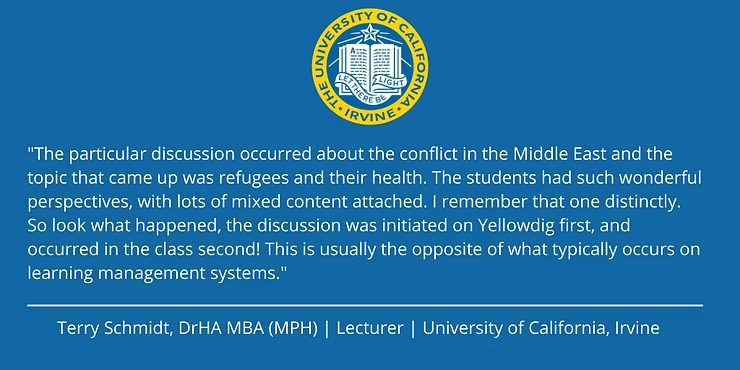
In this example the students were training to be health professionals and the course was a Graduate World Health Course. Faculty and students participated from institutions in the US, Taiwan, Japan, and New Zealand. All 4 schools followed the same syllabus, but most spoke in different languages. The asynchronous element allowed for students to have conversations that spanned these various languages, something that could not have happened efficiently in a synchronous course component. The unique perspective each student brought from their different cultural backgrounds enabled the students to walk away from the course with a more global perspective. This understanding will be critical for their interactions with diverse patients after they graduate.
Something unique but critical to the success of this course was that the grading was structured so that Yellowdig participation was upwards of 40% of the students’ grades. This motivated the students to ensure that bringing in and continuing discussions in Yellowdig was a big part of their weekly routine. This immense immersion into such a diverse community enabled the students to complete their final assignments which required multicultural perspectives.
Community Example #2: Two-Institution Partnership in an Asynchronous Format
This is an example of how two very creative institutions overcame replacing an in-person international exchange program with a virtual experience due to the limitations of COVID on travel. The exchange was between a US institution and a French institution. Their approach to this was not what you may have expected. Instead of simply requiring students based in the US to write in French and students based in France to write in English, the instructors set up Topics in Yellowdig, some in English and Some in French, and then all conversations regarding those topics happened in that language. (See topic examples below)
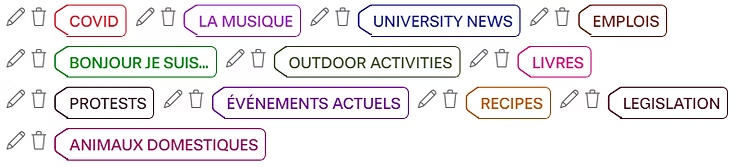
The beauty of this setup is that it enabled students to communicate with native speakers and help each other along the way as would have naturally happened if they were living in the foreign country. New speakers were able to pick up on the intricacies of their counterpart’s language, while engaging in conversations that interested both parties.
This community example is also running between a different Faculty at this U.S. Institution and a German Institution [English/German Language]
Community Example #3: Disruption-Proof Course Design
Our next example is one that any instructor can relate to this year. It is a hybrid-teaching student engagement example that provides consistent student engagement regardless of delivery modality. This is highly applicable to current challenges with uncertain or inconsistent modalities. The beauty of using an asynchronous student conversation tool is that no matter if students are on the same campus meeting their professor for 50 minutes 3 times a week in a classroom or sent home (likely with many students residing around the globe) and meeting their professor for a couple of hours each week over a video conference tool, students can still maintain relationships with their peers and continue the conversation from class throughout the week.
Providing students with this one piece of stability in such an uncertain environment can be very beneficial for their mental health and academic outcomes. The lack of a weekly assignment framework with weekly point buffers in Yellowdig can enable students to participate in the online discussion more often when they are unable to see their peers in-person, and take a break from Yellowdig when they have the opportunity to engage with their peers during live discussions. Yet, using Yellowdig does not just benefit the students when they are unexpectedly sent off campus. It can help bring in the students who need to run to their next class right after class, so they can’t hang around to ask their questions or finish that really interesting discussion that popped up in the last 5 minutes of class. All students benefit from conversing about course content more than the couple of synchronous blocks of time set aside in the syllabus, on or off campus.
Community Example #4: Single University, Global Campus
Our last example takes place with an institution that offers courses from local faculty across a global campus. Their main campus is based in the US and their satellite campus is located in China. Course offerings for students included courses from either campus location. Across campuses of this institution student-instructor, peer, and instructor-instructor interaction framework were shared to create a consistent and engaging learning environment.
One of the best uses to come out of this example was for Faculty to collaborate, co-create, and coordinate across international campuses. Enabling the faculty to be so in sync with each other and to learn firsthand how to use Yellowdig in a way that is not forced, but empowering, helped to create an equally engaging student experience for their learners at either campus.
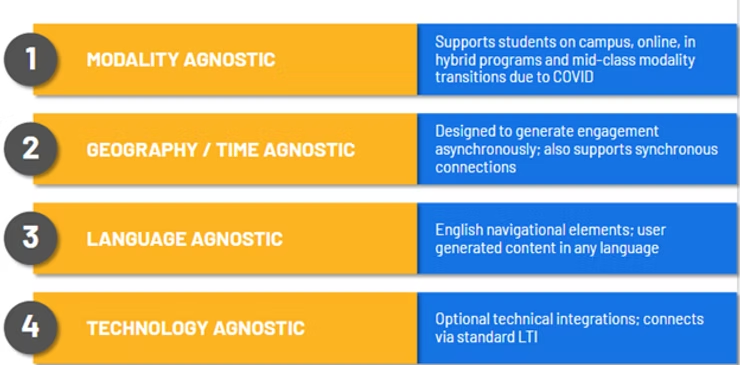
Now that we have discuss 4 examples of how various institutions have utilized Yellowdig’s unique platform to enable international communication, let’s take a moment to dive into why Yellowdig’s design is well suited for this situation.
To give some perspective on Yellowdig global student engagement, of our:
100+ institutions
4,000+ educators
10,000+ communities of learning
250,000+ learners
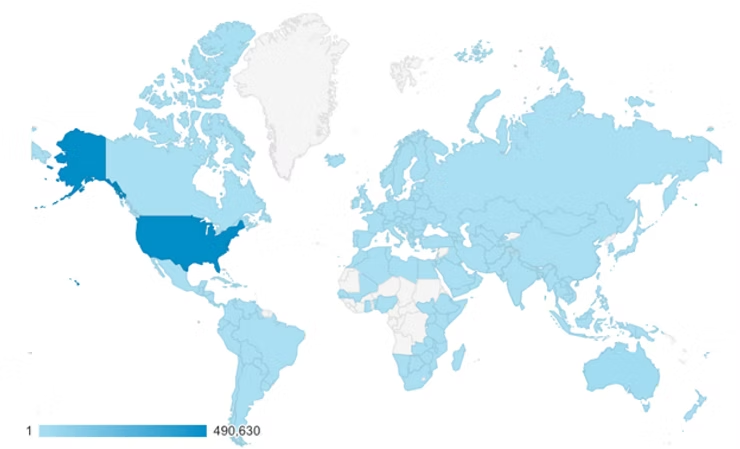
We have representation of users from almost everywhere on the map. (Oct 2019-Oct2020 data)
If you are an instructor, course designer, or other university faculty and now understand why one would choose to use Yellowdig for an international facing course and that Yellowdig has been used by a global audience, and are interested in trying Yellowdig out, we’d love to hear from you! You can claim a free trial for your course/institution of up to 200 students or feel free to reach out with any additional questions this blog sparked at learnmore@yellowdig.com.

This blog post is a recap of a workshop presented on December 1st 2020 titled “International Student Experience in 2021: Building Vibrant Learning Communities Across Borders” presented as a part of the Rebuilding the Global Village Conference hosted by CONAHEC and AMPEI. The workshop was facilitated by Brian Verdine, Ph.D – Yellowdig, Head of Client Success and Univ. of Delaware, Affiliated Asst. Professor of Education, Bob Ertischek, J.D. – Yellowdig, Academic Lead, and Deb Bolton – Yellowdig – CMO [Contract].
If you are interested in learning about more use case for Yellowdig beyond international student and faculty collaboration, take a look at our Efficacy E-Book.