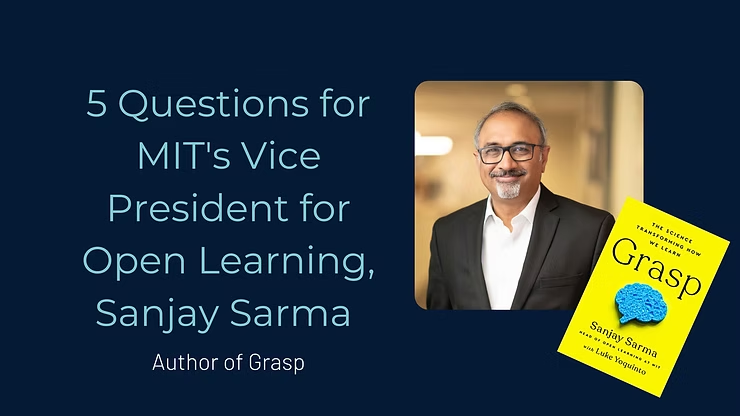
Sanjay Sarma is the Vice President for Open Learning at MIT, and the co-author of Grasp: The Science Transforming How We Learn. Along with Luke Yoquinto. Their book is a fantastic resource for teachers, professors looking for cutting-edge learning research, and parents evaluating educational opportunities. “Grasp takes readers across multiple frontiers, from fundamental neuroscience to cognitive psychology and beyond, as it explores the future of learning.”
He and I have been chatting about cognitive strategies in education and the realities COVID has revealed about our education system. Below are some of Sanjay’s expert opinions on topics that are on the forefront of re-shaping how education is approached.
Q: In interviews, you’ve said that COVID has revealed a hard truth about school: many classrooms already were effectively “socially distanced” to begin with, even before the pandemic began. What do you mean by that and, when we fully return to in-person school, how can we avoid continuing to make that mistake?
A: This time last year, when schools hastily began holding classes online, many students (to say nothing of their heroic teachers) had an extremely difficult experience, which felt to many like an indictment of online learning. But take a closer look at what has been happening at many “zoom schools”: hour after hour of synchronous lectures (that is, broadcast “live,” not pre-recorded), requiring the undivided attention of students either slumped over in boredom or white-knuckled with fear of getting lost. First of all, this is not online education as we do it at MITx and edX. We prerecord short, asynchronous lectures so that students can pause, slow down, and rewind them at will, while reserving synchronous class time for activities that require human interaction. Zoom school, in contrast, is a simple translation of the worst traditions of the classroom onto an online format. In fact, even when conducted in person, a top-down lecture delivered from a dais is rarely a cognitively sound tactic: It’s almost always too long for most students’ attention, and always too fast or too slow for the majority of students who are forced to take it in. When we return to classrooms full time, we must not fall back into such old, harmful patterns. Rather, let’s take the harsh lessons of this online period to make the classroom better. Let’s flip the classroom by turning lectures into short, pre-recorded videos to be ingested at the student’s preferred pace. That way, precious time in the classroom can be spent on activities best achieved face-to-face, such as discussion sections, Q&As, homework help sessions, field trips, and hands-on activities.
Q: Your book GRASP calls for a more “cognitively user-friendly” approach to instruction. What’s cognitively wrong with traditional instruction? What does a shift toward “cognitively user-friendly” education entail?
A: Cognitive science research has shed an astounding amount of light onto how learning works in the brain and mind–which only illustrates how little educationists knew a century or more ago, when they were setting up many of the educational institutions and traditions that remain with us to this day. In fact, it’s not too much of a stretch to say that the cognitive science of the 1920s remains frozen at the heart of educational systems in the US and around the world. An overwhelming focus at that time–animated, to be frank, by baldly racist theories–was less on transforming students than on sorting them according to who seemed most promising. Today, it’s become impossible to ignore the ways in which the sorting function of school routinely stands in the way of the cognitive demands of learning brains. And so a more cognitively user-friendly approach entails stepping back and asking whether we can even fit pro-cognitive practices into existing institutions (our answer: sometimes yes; sometimes no). And if not, how might a new institution work that better supports learning as we now understand it?
Q: How do students’ social and emotional needs factor into this framework?
A: We describe the demands of the learning brain as a towering “high-rise” of factors, ranging from the minuscule mechanisms of molecular neuroscience all the way up to the high-level concerns of psychologists and social scientists. A point we really try to drive home is that when something goes awry at any level of this high-rise, it can bring learning to a screeching halt. Students’ social and emotional needs, at the very top of the tower, are just as critical for successful learning as any process taking place down at the neuronal or brain-systems level. In fact, because such seemingly softer-edged concerns are all-too-easily ignored, they are especially demanding of educators’ attention, support, and creativity.
Q: Your book explores specific schools and programs that employ cognitively sound strategies. Is it possible to bring such strategies to vast scales?
A: The short answer is “Yes.” The longer answer is “Yes, but it’s not simple or trivial.” One of the signal challenges we discuss in GRASP is the question of how to scale up top-notch teaching and learning, without losing any of the “secret sauce” of successful educational relationships. Speaking broadly, there is a two-ended spectrum of approaches being tested in the ed-tech world right now, and each end comes with its own set of advantages and drawbacks. On one side, holistic-minded educators are seeking ways to bring “progressive” classrooms to scale without changing them much. On the other, reductionist technologists are seeking to distill the essence out of traditional classrooms and tutoring relationships in order to create an educational product ready for widespread dissemination. We argue for a hybrid approach: using technology for the educational tasks that it’s best suited for (especially: pre-recorded, asynchronous lectures)–never as a means to replace teachers, but rather to free up teacher and classroom time for the kinds of hands-on, context-forming activities that activate knowledge that would otherwise lie inert.
Q: Given your expertise, what is your view on how gameful learning (also referred to as gamification) can be used in education?
A: Games and learning have a long and complicated historical relationship. The potential for games to evoke curiosity (which is like rocket fuel for both attention and memory preservation) is immense. But too often throughout history, would-be ed reformers have set up instructional games that, when you look closely, are little more than window dressing on rote memorization exercises. Perhaps the most important difference between these sorts of mechanical drills and the more successful educational games out there is the social element. Does the game serve to isolate the learner in a little mental Skinner box, or does it create a warm world of social motivation and informational context? When a game does the latter, it can be a powerful learning tool, indeed.
Learn how Yellowdig uses social elements as a core part of learning.