
February 25, 2022

Online Learning vs. Traditional Learning: Is Online College Cheaper

Unlocking Student Motivation with Gameful Learning

Instructors everywhere face the same uphill climb: getting students to participate meaningfully—especially in online classes. Despite your best efforts, traditional discussion forums can feel more like boxes to check than places for real learning. What’s the antidote? For many educators, the answer is gameful learning.

What is Gameful Learning?

Gameful learning isn’t about turning your classroom into an arcade. It’s about applying the elements of games—clear goals, meaningful choice, and immediate feedback—to academic environments. Platforms like Yellowdig use points, badges, and accolades to recognize real contributions, making participation feel rewarding, not obligatory.

Why Gameful Elements Spark Engagement

Why do students respond so well to this approach? Because gameful mechanics tap into motivation in ways that rote assignments can’t. When students earn points for thoughtful posts or insightful replies, they're encouraged to dig deeper and share experiences. A little friendly competition doesn’t hurt, either—leaderboards spark engagement and help shy students ease into participation.

Yellowdig’s Approach: More Than Just Points

Yellowdig’s platform is built around the idea that engagement should be authentic, not forced. Points aren’t given for empty “I agree” comments, but for contributions that spark conversation and critical thinking. Students can curate their posts with articles or videos that interest them and receive recognition when others interact with their content. This approach fosters intrinsic motivation—students participate because they want to, not because they have to.

Real Results in Real Classrooms

Instructors using Yellowdig consistently report stronger participation and deeper discussion. One faculty member noted that “seventy-five percent of student questions get answered by their peers,” freeing up their time to tackle more advanced topics. Students say they look forward to checking new posts, sharing resources, and earning recognition for meaningful contributions.

Tips for Making Gameful Learning Work

  1. Set Clear Expectations: Let students know how points are earned and celebrate thoughtful interaction, not just frequency.
  2. Offer Meaningful Feedback: Use accolades and comments to highlight particularly insightful posts.
  3. Encourage Creativity: Remind students they can use links, visuals, or even short videos to make their posts stand out.
  4. Foster Healthy Competition: Leaderboards and weekly challenges can energize participation and keep momentum going.

The Takeaway

Gameful learning turns participation from a chore into an opportunity for discovery and community. With the right design, recognition, and tools, you’ll see students take more ownership of their learning—unlocking not just better engagement, but genuine excitement for the subject.
Ready to see how gameful learning can transform your course? Try out Yellowdig and join a thriving community that believes learning should be as rewarding as it is rigorous.

Making the decision to enroll at a university can be a daunting task because of the financial burden that higher education places on its students. Students are expected to take out large loans to finance their education right out of high school because a traditional college education costs more than most Americans can afford. In fact, only 17% of American families can afford sending their children to college without borrowing money from the federal government or a private bank. With higher education being a must for many careers, we must evolve the educational landscape to match the financial reality of the majority of Americans.

Luckily, there is one solution to this problem: online education. Because of the lack of inherent costs of the typical brick and mortar education, virtual classes can save learners thousands of dollars on their tuition. Let’s dive into the costs of both a traditional public school and a fully online education to see just how much more money you need to spend attending in-person classes.

Traditional education Vs. Online education
Tuition

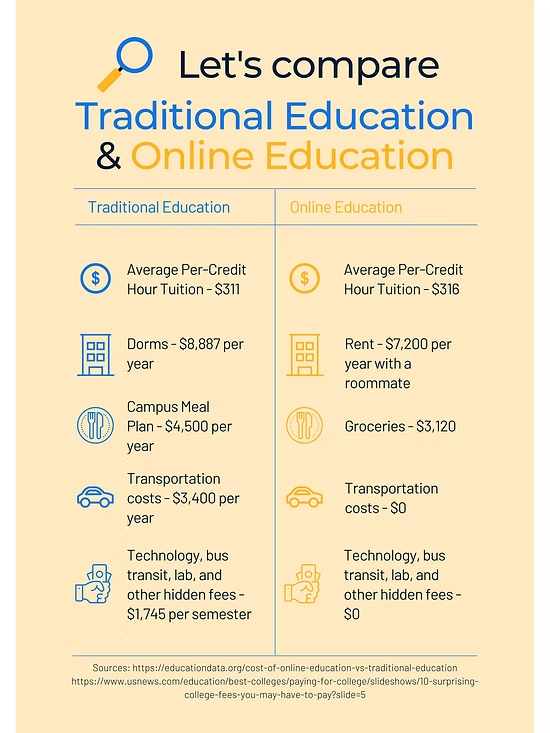
Although the tuition per credit hour is comparable between traditional and online education at most colleges and universities, the other costs that incur in a traditional education setting are staggering when compared to an online education. For example, student who attend virtual classes saves money by not worrying about transportation costs. Not only do students who commute to school need to worry about gas money, but they also have to worry about the wear and tear they put on their vehicles. With that being said, living on or near campus could eliminate transportation costs for students if their classes were within walking distance.

Living and food expenses

Other needs and essential services, such as somewhere to live and cost of food, are reduced if not living on campus. The average campus meal plan costs $4,500 a year while groceries average around $3,120 a year per student. Dorms are also more expensive than living in an off-campus apartment. The average dorm costs almost $9,000 a year while an apartment off-campus costs $7,200 a year with a roommate in an apartment that charges $1,200 a month. The cost of an apartment can be even cheaper depending on how many roommates you live with.

Hidden Fees

Students who attend physical classrooms are also charged many hidden fees that online students aren’t responsible for. One common fee students may see in their tuition bill is a “campus fee” which is charged to each student in order to maintain the campus in various ways. This fee can go toward general building maintenance, landscaping, construction maintenance, and more. Rutgers University charges upwards of $1,347 for general campus upkeep for each student attending school on a physical campus while students attending an online school are exempt from these fees.

Cheaper Online Education Allows For More Flexibility

Online education inherently makes learning more flexible for students by giving them more options in when and where they want to learn, but with online programs being cheaper than going to a traditional college, it opens doors to even more flexibility for students. There are many reasons students may consider online vs in-person education. For some students, receiving a high quality education can be difficult depending on where they live. Those in rural areas may have to commute a long distance or unwillingly move away from their hometown in order to attend college. Other students may find that their local university isn’t the right fit for them.

Online courses have changed the game by offering students a way to receive a higher education on their own terms. Because online education is cheaper than going to a physical classroom, students have the opportunity to choose a college from anywhere in the country. In fact, many online universities don’t charge out-of-state tuition.

A Great Solution to an Old Problem

Many people have been barred from a college education since the inception of higher education because of their socioeconomic status, but online education can be the change we need to see in order to rectify this problem. Online education ultimately makes education more accessible, which is exactly what we need in order to ensure receiving a higher education is possible for everyone.


Keep reading
Yellowdig
Want a Yellowdig Community that doesn’t suck? Follow our best practices.

In 2020, we created a composite Community Health metric that captures four key dimensions of student engagement and achievement. Along the way, we confirmed something we already knew: instructors who use many of our best practices have Communities that perform significantly better than instructors who use fewer. Over the past 3 years, we’ve continued to […]

Product Updates
Yellowdig Engage Product Update 2/19

Features: Password complexity checking. This strengthens the security of users’ accounts. Post reply-to threading UI. This distinguishes replies to comments from replies to posts, making it easier to read and track long conversations. Avatar hover card. This allows users to follow and directly message each other by hovering over their picture in the feed. Interactive […]

Student Success
The Textbook’s Crumbling Monopoly

But that is no longer the case today. The textbook’s monopoly on knowledge is crumbling (if it hasn’t already). Scan any university campus or peek in on any dorm room and you will see fewer books. Why? Well aside from the astronomically inflated cost of textbooks at campus bookstores, the model in which students acquire […]

See Yellowdig in Action Today

Experience how effortless engagement and real community can transform your classroom or campus. Book your personalized walkthrough—no pressure, just real results.