March 10, 2022

Resiliency in Academia: Lessons Learned from COVID-19

Unlocking Student Motivation with Gameful Learning

Instructors everywhere face the same uphill climb: getting students to participate meaningfully—especially in online classes. Despite your best efforts, traditional discussion forums can feel more like boxes to check than places for real learning. What’s the antidote? For many educators, the answer is gameful learning.

What is Gameful Learning?

Gameful learning isn’t about turning your classroom into an arcade. It’s about applying the elements of games—clear goals, meaningful choice, and immediate feedback—to academic environments. Platforms like Yellowdig use points, badges, and accolades to recognize real contributions, making participation feel rewarding, not obligatory.

Why Gameful Elements Spark Engagement

Why do students respond so well to this approach? Because gameful mechanics tap into motivation in ways that rote assignments can’t. When students earn points for thoughtful posts or insightful replies, they're encouraged to dig deeper and share experiences. A little friendly competition doesn’t hurt, either—leaderboards spark engagement and help shy students ease into participation.

Yellowdig’s Approach: More Than Just Points

Yellowdig’s platform is built around the idea that engagement should be authentic, not forced. Points aren’t given for empty “I agree” comments, but for contributions that spark conversation and critical thinking. Students can curate their posts with articles or videos that interest them and receive recognition when others interact with their content. This approach fosters intrinsic motivation—students participate because they want to, not because they have to.

Real Results in Real Classrooms

Instructors using Yellowdig consistently report stronger participation and deeper discussion. One faculty member noted that “seventy-five percent of student questions get answered by their peers,” freeing up their time to tackle more advanced topics. Students say they look forward to checking new posts, sharing resources, and earning recognition for meaningful contributions.

Tips for Making Gameful Learning Work

  1. Set Clear Expectations: Let students know how points are earned and celebrate thoughtful interaction, not just frequency.
  2. Offer Meaningful Feedback: Use accolades and comments to highlight particularly insightful posts.
  3. Encourage Creativity: Remind students they can use links, visuals, or even short videos to make their posts stand out.
  4. Foster Healthy Competition: Leaderboards and weekly challenges can energize participation and keep momentum going.

The Takeaway

Gameful learning turns participation from a chore into an opportunity for discovery and community. With the right design, recognition, and tools, you’ll see students take more ownership of their learning—unlocking not just better engagement, but genuine excitement for the subject.
Ready to see how gameful learning can transform your course? Try out Yellowdig and join a thriving community that believes learning should be as rewarding as it is rigorous.

With such decreased physical distance between learner and faculty during the COVID-19 pandemic, the typical world of academia was flipped upside-down. Without choice, faculty had to adjust to their new concerns within their profession while balancing the heavy toll of what is COVID-19. This is no small feat.

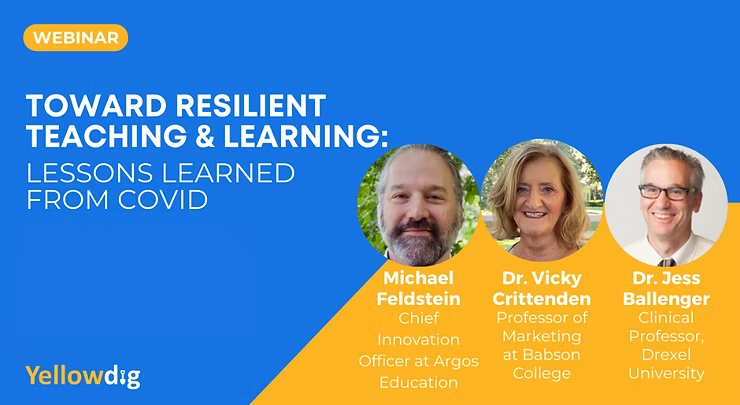
But in this time, faculty rose to the challenge, and they used the time to truly think about and reframe their goals. This speaks to the resiliency of the modern instructor. On March 1st, Yellowdig hosted a webinar, moderated by Michael Feldstein and featuring Dr. Vicky Crittenden, Dr. Jesse Ballenger, and Shaunak Roy.

Meet The Speakers

Michael Feldstein, Chief Innovation Officer at Argos Education

Dr. Vicky Crittenden, Professor of Marketing at Babson College

Dr. Jesse Ballenger, Clinical Professor at Drexel University

Shaunak Roy, Founder and CEO of Yellowdig

Experience Insight

From the past two years, one of the greatest lessons we have learned is centered around vulnerability. Nothing can achieve the highly sought after, yet impossible title of perfection– and this is something that faculty, learners, and the world alike had to learn.

So where did this leave academia faculty? Dr. Jess Ballenger reflects on his experience in managing challenges, expectations, and connection. For him, and the many attendees in the chat sharing their experiences, one of the hardest transitions was going from a face-to-face environment to a synchronous virtual classroom, where students– for varying valid reasons– did not turn on their cameras. This dichotomy between respecting students’ lack of camera use and feeling an energy drain from within while teaching was the subject of a great amount of thought into how to make this world better.
What Does the Research Say?

Dr. Vicky Crittenden had recently edited an article discussing faculty burnout due to COVID-19 for the Journal of Marketing Education. From the research she saw as well as her own experiences as a faculty member in the Marketing department, the barrier between home and work life was completely shattered. However, she says, “another word that has come out here was empathy.”

For the past two years, the world has been experiencing extremely connected emotional sensations due to the sheer impact of the pandemic. On the academia level, faculty and students have been so united in their struggles and sheer realness that has prompted a new level of empathy. However, at the same time, this connected feeling, in a way, contributed to faculty burnout from immense internalization of student feelings as well as their own.

As the CEO of an EdTech company, Shaunak Roy was faced with a new challenge– updating his platform to fit the needs of faculty. What he discovered was that more was needed than just talking to faculty on how to best support them; it was important to “engage with them more in the design phase of when they’re actually thinking about using technology to kind of unpack the problem” in addition.

Being Comfortable With Discomfort

In general, Jess says, teaching is about the unpredictability of class discussions and being comfortable within that sphere. He says:

“For that pedagogy to be successful, you have to accept a kind of unpredictability, like, if you’re going to tell people ‘I want to hear what you have to say,’ and this is what this class is about, you actually have to embrace what they say and sort of go with it. You can’t mow people down. You can’t dismiss… You kind of have to go in openly and [it’s] preparing yourself for the various sorts of things that have to happen.”
This openness was challenged, again, when synchronous meetings moved to an asynchronous fashion. It was about finding a way to recreate discussion when not meeting in real time. When the unpredictability of class becomes unpredictable, faculty gets creative and are pushed past previous norms– true resiliency.
Vicky chimed in with great insight into this paradox, adding that “controlled learning is passive learning.” It is not about letting go of control in the classroom in a COVID world, but 2020 also added insight into conversations regarding diversity, equity, and inclusion. Vicky discussed her gratitude for access to EdTech that helped to keep her connected to her students to promote active learning without keeping complete control of class topics and discussions. She speaks to her appreciation for technology in this time by saying:
“How can I, as a faculty member, know at what point I’m willing to give up control. And, I think that technology has enabled that… It’s a wonderful experience to combine those two– giving up control because of the technology.”

This conversation was a great insight into resilient teaching through the past two years and beyond. Thank you to our four panelists for their open and authentic words. This post is just a quick recap on some of the topics discussed. There is so much more to hear in the full webinar. Check out the full video here.


Keep reading
Yellowdig
Want a Yellowdig Community that doesn’t suck? Follow our best practices.

In 2020, we created a composite Community Health metric that captures four key dimensions of student engagement and achievement. Along the way, we confirmed something we already knew: instructors who use many of our best practices have Communities that perform significantly better than instructors who use fewer. Over the past 3 years, we’ve continued to […]

Product Updates
Yellowdig Engage Product Update 2/19

Features: Password complexity checking. This strengthens the security of users’ accounts. Post reply-to threading UI. This distinguishes replies to comments from replies to posts, making it easier to read and track long conversations. Avatar hover card. This allows users to follow and directly message each other by hovering over their picture in the feed. Interactive […]

Student Success
The Textbook’s Crumbling Monopoly

But that is no longer the case today. The textbook’s monopoly on knowledge is crumbling (if it hasn’t already). Scan any university campus or peek in on any dorm room and you will see fewer books. Why? Well aside from the astronomically inflated cost of textbooks at campus bookstores, the model in which students acquire […]

See Yellowdig in Action Today

Experience how effortless engagement and real community can transform your classroom or campus. Book your personalized walkthrough—no pressure, just real results.