The education environment constantly changes as learners develop and as we usher in new generations of learners. But with so much constant change, grading remained a stagnant variable in its nature. Despite much rethinking, trials, and tribulations with the grading system, why has it remained unchanged? Traditional grading is easy, convenient, and the norm, so it is understandable that it has remained as popular as it is, but the cons that come with it should be taken into strong consideration.
Even prior to COVID, traditional grading has been facing scrutiny from instructors and learners alike. The impact of the pandemic has created a larger call for action to amend a system that has its flaws. Per NEA, the three major long-standing objections to traditional grading practices are that they do not accurately measure student learning, they do not intrinsically motivate, and they focus too much on non-academic factors such as punctuality or compliance. All of these factors lead to some unwanted academic outcomes for learners, but traditional grading also adds an extra level of stress and workload for instructors as they spend free time reading and examining each learner’s papers or exams. With the valid woe of faculty burnout separating instructors from what they love about their roles, the sheer amount of time spent grading does not lend itself to a healthy learning or instructing environment for anyone. Though qualitative grading that focuses on excellent individualized feedback can lead to positive learning outcomes, it takes a huge toll on the lives and time of instructors. However, there is a happy medium of student motivation, instructor time-saving, and satisfaction for both groups.
This blog will explore 3 ways to reduce time spent grading, including trying different systems than the traditional grading method. Here are our methods of reduction:
Incorporate Participation-Based Grading
Grade as you Go
Use EdTech

Incorporate Participation-Based Grading
Points-based grading is a seemingly logical and valid way to assess learners’ understandings of a specific course concept. However, the stigma of specific numbers or letter grades is the issue that many find with this system. With this, it is very common to add up the point grades of all of the individual mini-assignments into one major point grade. This turns formative assessments into summative ones, a gripe that some learners have with the education system.

Instead of following this system that is riddled with negative comparison effects for learners and stress, adopting a participation-based approach could reduce the negative feelings learners have with numbers or letters by cutting out the source. Learners understand concepts in a variety of ways and express that understanding using different methods. No one person’s learning strategy is better than another’s, which is why participation-based grading creates a level playing field for learners. The importance of education is in learning and mastering concepts that will help learners, so participation-based grading allows for this learning to happen and to grow. It also provides a safe space for learning– research shows that in order to learn, people need to feel safe to make mistakes.
Additionally, participation-based grading reduces time spent grading for instructors immensely. Grading from this angle eliminates the hours and hours that go into close reading of learners’ content.
Grade-As-You-Go

Time management is a difficult thing to grasp at all ages and stages of life. Instructors have to balance many situations and identities all at once, the two most prominent being work-life and personal-life. Traditional grading comes with an assumption of personal-life time being used as work-life time, as it can be done anywhere. The school day being over does not always mean the end of the work day with a traditional grading method, which is not a good thing– it crosses the boundaries of the work-life balance.
Use EdTech
Technology in the classroom is an asset– it makes things easier, more connected, and even automated. Using EdTech changes the academic environment for the better as it increases accessibility, creates flexibility, and can lower the cost of education. Off the bat, these three aspects enhance the learning experience, but they can also be used as devices to help instructors save time.
Virtual tools can alleviate grading stresses and times by allowing for automated grading. Learners can complete tasks and receive a grade in real-time, helping instructors by reducing grading on their to-do lists, but it also helps learners. Seeing a grade and being able to see mistakes right after completing the assignment allows students to correct errors and learn right away, as opposed to receiving a grade days or weeks later when the information is not seemingly pertinent to their timeline anymore.
However, not all tools are created equal. It is important to use a platform or service that enhances the learning experience and does not just grade based on specific parameters that made students feel unsafe or stressed by grades in the first place.
The Solution?
Yellowdig, an online learning community platform, actually helps instructors do all three of these things. When using Yellowdig, instructors can modify settings in their community to maximize the efficiency of their course, but all learners are graded on participation. Yellowdig is all about the positive learning outcomes that follow high connection and communication (i.e. higher engagement, higher retention rate, greater satisfaction). With this tenet, the base of a learner’s grade is their participation through posting, commenting, or receiving reactions, measured in points.
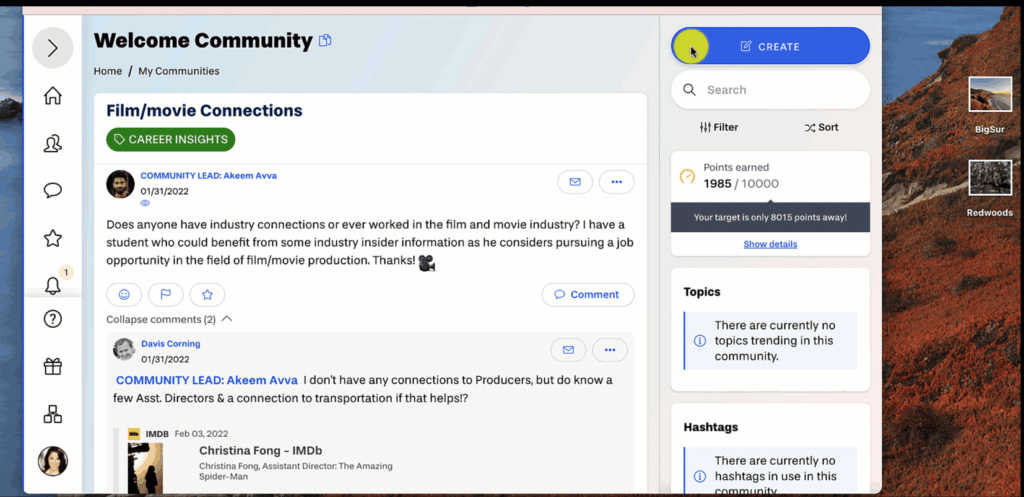
This already saves time, but Yellowdig can also easily connect and upload into any LMS (Learning Management System) to allow for immediate feedback and grade transfer. This gives back precious time that instructors need to focus on the heart of their teaching and also it helps create a course community that learners and instructors feel empowered by.
Real Instructor Stories
Yellowdig instructors report saving a lot of time by using the platform, and they also report high satisfaction rates in their journey of teaching. Listen to these instructors themselves through what they say!
“Thus far, I really like Yellowdig! We’re using it mainly as a place where students can ask questions about the coursework and respond to each other. About 75% of the students’ questions are answered sufficiently by other students, which is a huge timesaver and it lets me focus on the more challenging questions that students have. I LOVE that students are able to get points for asking and/or answering questions. I can see that some students mainly get their points through posting questions and some mainly get points by answering questions. The students who are answering questions really “get” the content and I’m glad they’re not forced to post questions!” –McKinzie Sutter, University of Nebraska-Lincoln
“[Yellowdig] helps engage students and simplifies tracking participation. Not constantly grading and trying to get participation frees me to spend more time being a good teacher… and it is a lot more fun.” -Tawnya Means, University of Nebraska-Lincoln
“Previously, I was hand-grading discussions twice a week for 50-plus people in addition to other assignments. Yellowdig automatically grades discussion boards, allowing me to intentionally focus my attention on other high-impact areas.” -Stephanie Raible, University of Delaware
“Yellowdig provides a user-friendly way for my students to interact with each other and the instructional team without adding to our already large grading load. While graded primarily on quantity, the quality of posts does not differ from previous sessions where students were hand graded on quality.” -Rhian Sotts, Arizona State University
“It relieved me of the burden of managing and grading a discussion board, while empowering my students to take charge of their discussion, without the feeling of being constantly monitored by the instructor.” -Kelly O’Brien, California State University Monterey Bay, College of Business
Start your Yellowdig journey now by clicking the button below!