
December 2, 2022

School of Social and Behavioral Sciences

Unlocking Student Motivation with Gameful Learning

Instructors everywhere face the same uphill climb: getting students to participate meaningfully—especially in online classes. Despite your best efforts, traditional discussion forums can feel more like boxes to check than places for real learning. What’s the antidote? For many educators, the answer is gameful learning.

What is Gameful Learning?

Gameful learning isn’t about turning your classroom into an arcade. It’s about applying the elements of games—clear goals, meaningful choice, and immediate feedback—to academic environments. Platforms like Yellowdig use points, badges, and accolades to recognize real contributions, making participation feel rewarding, not obligatory.

Why Gameful Elements Spark Engagement

Why do students respond so well to this approach? Because gameful mechanics tap into motivation in ways that rote assignments can’t. When students earn points for thoughtful posts or insightful replies, they're encouraged to dig deeper and share experiences. A little friendly competition doesn’t hurt, either—leaderboards spark engagement and help shy students ease into participation.

Yellowdig’s Approach: More Than Just Points

Yellowdig’s platform is built around the idea that engagement should be authentic, not forced. Points aren’t given for empty “I agree” comments, but for contributions that spark conversation and critical thinking. Students can curate their posts with articles or videos that interest them and receive recognition when others interact with their content. This approach fosters intrinsic motivation—students participate because they want to, not because they have to.

Real Results in Real Classrooms

Instructors using Yellowdig consistently report stronger participation and deeper discussion. One faculty member noted that “seventy-five percent of student questions get answered by their peers,” freeing up their time to tackle more advanced topics. Students say they look forward to checking new posts, sharing resources, and earning recognition for meaningful contributions.

Tips for Making Gameful Learning Work

  1. Set Clear Expectations: Let students know how points are earned and celebrate thoughtful interaction, not just frequency.
  2. Offer Meaningful Feedback: Use accolades and comments to highlight particularly insightful posts.
  3. Encourage Creativity: Remind students they can use links, visuals, or even short videos to make their posts stand out.
  4. Foster Healthy Competition: Leaderboards and weekly challenges can energize participation and keep momentum going.

The Takeaway

Gameful learning turns participation from a chore into an opportunity for discovery and community. With the right design, recognition, and tools, you’ll see students take more ownership of their learning—unlocking not just better engagement, but genuine excitement for the subject.
Ready to see how gameful learning can transform your course? Try out Yellowdig and join a thriving community that believes learning should be as rewarding as it is rigorous.

Interview with Professor Nicholas Duran

Arizona State University

School of Social and Behavioral Sciences

Assistant Professor

One piece of advice from Professor Duran to fellow Yellowdig instructors:

“In large online courses, I really emphasize Yellowdig participation as it’s the only way students can really get to know and interact with each other. I also make it the least demanding component of my overall assessment each week, where there is a lot of room to explore the big themes for whatever content I might be covering.”


How Professor Duran Uses Yellowdig:

Between Fall 2017 and Summer 2019, Professor Duran used Yellowdig for 7 graduate and undergraduate courses in psychology and cognitive science. Professor Duran teaches a mix of online and offline courses with large enrollments. Teams of graduate TA’s help Professor Duran moderate his high-enrollment Communities, and he encourages his TA’s to kickstart conversations by posting articles and sharing their views on course topics. Professor Duran also uses Yellowdig as an opportunity to familiarize his graduate students with subject matter outside their areas of specialization. He even finds that using Yellowdig helps him keep abreast of recent developments in his field. Finally, Professor Duran uses Yellowdig to identify promising undergraduates to work in his lab.

Yellowdig was a graded component of Professor Duran’s courses, and students’ Yellowdig grades were typically worth 20-25% of their final grades.

Professor Duran’s Results:

On average, students in Professor Duran’s Communities created 46 Posts and Comments and earned 99% of the 100% participation goal. The average conversation ratio (Comments / Posts) was 2.67, which could be increased by adding social points. In Professor Duran’s most recent undergraduate course, students were well-connected to each other despite the large class size; the average Community member responded to or received responses from 34 other active Community members. (See network graph.)


Overall, our data suggest that Professor Duran and his TA’s fostered strong and engaging Communities. One way for Professor Duran to further strengthen his Communities would be to increase the value of social points, which tend to increase high-quality posts, peer interactions, and student engagement.
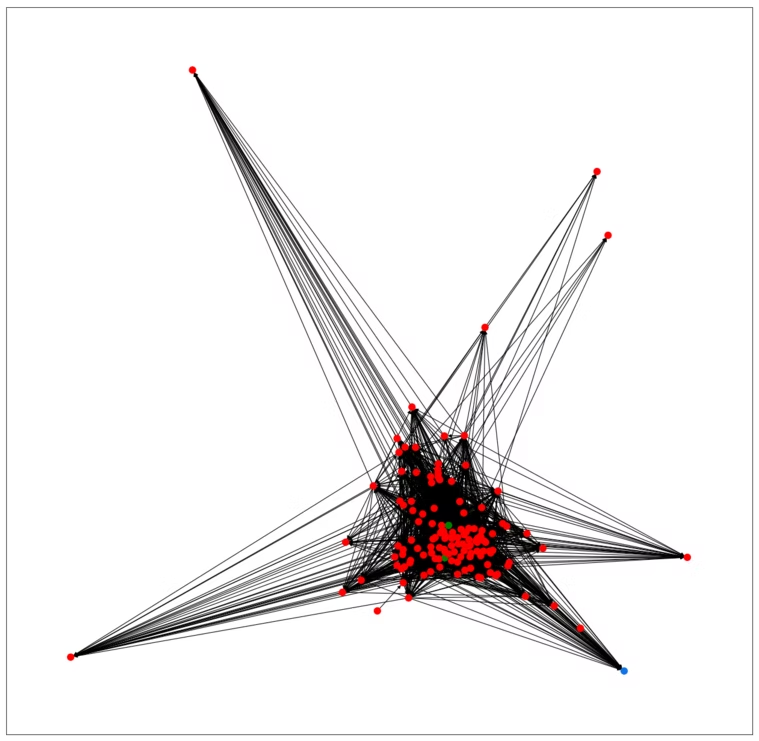
The abbreviated network graph (left) and breakdown of settings (below) depict Prof. Duran’s most recent undergraduate cognitive science Community (S19). The red nodes in the network graph represent students; the green nodes represent TA’s; and the blue node represents Prof. Duran.

Prof. Duran and his TA’s divided their labor. TA’s commented on students’ posts (avg. out-degree centrality = 0.16), while Prof. Duran created posts for students to comment on (in-degree centrality = 0.35). Students who never commented or posted were excluded from the analysis.

About Professor Duran:

Professor Duran earned his Ph.D. in Cognitive Psychology at the University of Memphis and served as a postdoc at the University of California Merced. He is the Director of ASU’s DynamiCog Lab, an interdisciplinary lab dedicated to applying cognitive research to real-world settings. Professor Duran works on coordination, deception, bias, and perspective-taking, among other topics.


Keep reading
Yellowdig
Want a Yellowdig Community that doesn’t suck? Follow our best practices.

In 2020, we created a composite Community Health metric that captures four key dimensions of student engagement and achievement. Along the way, we confirmed something we already knew: instructors who use many of our best practices have Communities that perform significantly better than instructors who use fewer. Over the past 3 years, we’ve continued to […]

Product Updates
Yellowdig Engage Product Update 2/19

Features: Password complexity checking. This strengthens the security of users’ accounts. Post reply-to threading UI. This distinguishes replies to comments from replies to posts, making it easier to read and track long conversations. Avatar hover card. This allows users to follow and directly message each other by hovering over their picture in the feed. Interactive […]

Student Success
The Textbook’s Crumbling Monopoly

But that is no longer the case today. The textbook’s monopoly on knowledge is crumbling (if it hasn’t already). Scan any university campus or peek in on any dorm room and you will see fewer books. Why? Well aside from the astronomically inflated cost of textbooks at campus bookstores, the model in which students acquire […]

See Yellowdig in Action Today

Experience how effortless engagement and real community can transform your classroom or campus. Book your personalized walkthrough—no pressure, just real results.