
Higher Student Engagement on Yellowdig Leads to Better Grades
Fort Hays State University Deems Social Learning Platform, Yellowdig, a ‘Powerful’ Addition to Marketing Courses
Dr. Andrew Feldstein, Dr. Mary C. Martin, and Dr. Michael J. Martin of Fort Hays State University participated in a pilot program where Yellowdig, a social learning platform, was used across four marketing classes to study its effectiveness in increasing student engagement and improving student learning. In the marketing classes, Yellowdig was used for two purposes: as a way to create a community inside and out of the classroom, and as a means by which students could create and share course-relevant content throughout the semester. Course data was analyzed by the university to suggest that engagement and course participation through Yellowdig does benefit student learning.
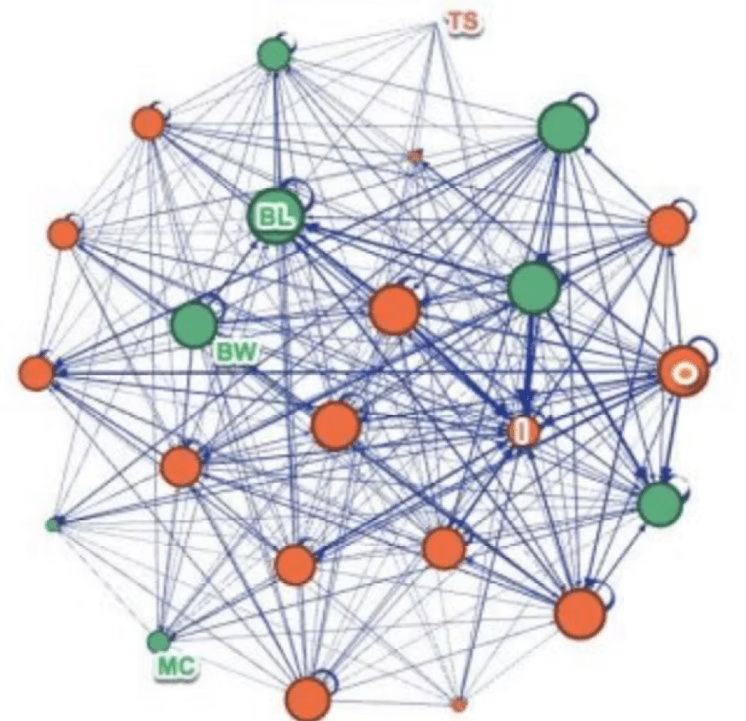
Yellowdig builds a “social learning network” for academic courses. This data visualization was created by Fort Hays State University using Yellowdig interaction data from a Social Media Marketing Class.
About the Fort Hays - Yellowdig Pilot
Fort Hays State University piloted Yellowdig in two marketing courses, each of the two courses offering a face-to-face section and an online section, all four of which implemented Yellowdig throughout a semester. Students were instructed to share course-relevant content by posting (“pinning”) items of interest relating to the content being covered, as well as articles, videos, and other webpages related to their personal interests or experiences. Students’ Yellowdig activities were counted as part of their course grades. To earn full credit for the Yellowdig portion, students needed to earn at least 300 points over the course of the semester by adding pins and by commenting on and earning loves or likes from their peers.
In the face-to- face (on-campus) courses, Fort Hays used Yellowdig to structure or supplement class discussions. Prior to meeting, the instructors would select one or more articles posted on Yellowdig. Then, in class, the instructors would ask a particular student who posted a particular article to summarize the article. Since other students had up-voted or commented on the article, the instructor would also ask for their opinion of the article. The incorporation of the Yellowdig content into class discussions held the students accountable for their individual-level and social activities, and allowed discussions to focus on interesting content relevant to the course.
In the online courses, Yellowdig allowed students to connect and engage in ways not possible with discussion boards through a typical learning management system. While students can comment on others’ posts in a discussion board, the ability for students to up-vote and comment in Yellowdig and to gain a level of influence in the community (through up-votes and gaining followers), along with content being organized through topics (hashtags), brings individual-level contributions and social interactions to a higher level of engagement and social learning.
Fort Hays Analysis
Summary reports for the semester were generated and downloaded from Yellowdig, along with students’ course grades. The Yellowdig platform allowed assessment of individual contributions and social interactions, and both types of actions were assessed. Data visualization and social network analyses were conducted to better understand social interactions taking place within a course, as well as individual student contributions to the classroom community. Multiple linear regression was used to determine whether students’ course grades (learning) can be predicted by their engagement in a course.
Fort Hays Findings
The analysis conducted by Fort Hays suggests that engagement through Yellowdig benefits student learning. Students with higher grades read and commented on more articles throughout the semester which complimented the content they were learning in other aspects of the course.
Yellowdig offers a way for students to integrate theory and practice as they participate in more traditional classroom activities (textbook reading, tests, projects). When students are seeking new and interesting content on a daily basis and bringing it to the classroom with their own take on it, that integration between theory and practice comes alive and students become more active learners by taking more responsibility for their learning. In the marketing classroom, in particular, social learning and the use of social media platforms like Yellowdig can be powerful. Yellowdig can engage students in course content and help marketing majors become more adept at using social media, a skill many will need as the market for graduates with social media marketing experience continues to grow. Rather than traditional summative assessment, whereby student learning is evaluated at the end of an instructional unit by comparing it against some standard or benchmark (e.g., a final paper or project), Yellowdig allows instructors to conduct formative assessment. With formative assessment, student learning and engagement are monitored to provide ongoing feedback to students.
Fort Hays believes social learning through social media platforms like Yellowdig will enhance instructor and student experiences and, ultimately, [enhance] student engagement and learning.
Source: Martin, M. C., Martin, M. J., & Feldstein, A. P. (2017). Using Yellowdig in Marketing Courses: An Analysis of Individual Contributions and Social Interactions in Online Classroom Communities and Their Impact on Student Learning and Engagement. Global Journal of Business Pedagogy, 1(1), 55–73.