In case you missed it, the Department of Education (DOE) finally released the last set of regulations from its epic 2019 negotiated rule-making process on April 1st 2020. WCET has a comprehensive list of blogs with the latest updates from the DOE.
Make sure your online classroom complies with the DOE's April 2020 Update
These new regulations require regular and substantive interaction defined as follows (emphasis added):
For purposes of this definition, substantive interaction is engaging students in teaching, learning, and assessment, consistent with the content under discussion, and also includes at least two of the following —
– Providing direct instruction;
– Assessing or providing feedback on a student’s coursework;
– Providing information or responding to questions about the content of a course or competency;
– Facilitating a group discussion regarding the content of a course or competency; or,
– Other instructional activities approved by the institution’s or program’s accrediting agency.
An institution ensures regular interaction between a student and an instructor or instructors by, prior to the student’s completion of a course or competency—
– Providing the opportunity for substantive interactions with the student on a predictable and regular basis commensurate with the length of time and the amount of content in the course or competency; and
– Monitoring the student’s academic engagement and success and ensuring that an instructor is responsible for promptly and proactively engaging in substantive interaction with the student when needed, on the basis of such monitoring, or upon request by the student.
Considering there are some specific guidelines to follow, any solution would require careful consideration of the student & faculty experience, ease of use, workload, measurement, and access to data.
Yellowdig’s solution is deeply rooted in pedagogy, which goes beyond compliance. We offer a solution that not only has demonstrated substantial improvement in learning outcomes, but is designed to improve student engagement and satisfaction. Yellowdig is a solution that encourages both students and instructors to participate and that they actually love to use, which makes regular & substantive interaction enjoyable rather than burdensome.
The below section provides a platform overview and some of the relevant features and functionality that will come in handy to meet the needs of this specific regulation.

Yellowdig’s platform overview:
Yellowdig is a community-building system that connects learners and empowers educators. Learners and instructors interact within a gamified system that provides an easy means for learners and other users to communicate and collaborate about class content, share a broad array of timely and relevant learning resources from the wider world (e.g., videos, news articles, blogs and more), and use modern social features like direct messages, emoji reactions, hashtags, @ mentions, and notifications.
The intuitive design, automatic tracking of participation, and data-tracking capabilities allow monitoring of student-student and instructor-student interactions. These data feedback into a number of features that ensure predictable, regular, and easily reportable interactions between students and their instructors.
Points System:
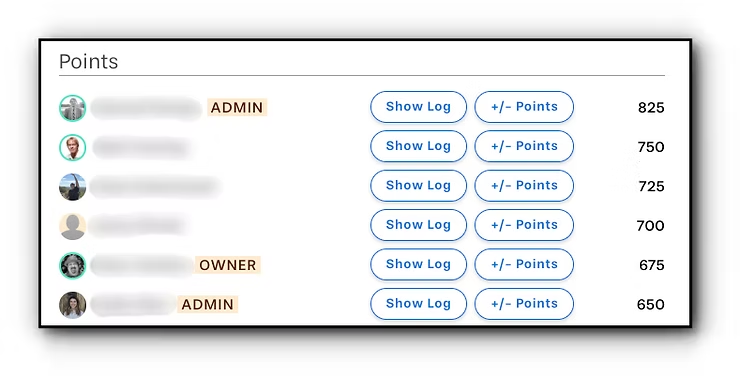
Yellowdig’s point tracking system, which monitors both student and instructional team participation, solves the problem of proving regular and substantive interaction with instructors. The rules in the point system requires students to engage throughout the course to improve their participation grade and prove attendance. The instructional team is shown and participates with the same point system, which makes it easy to quantify the amount of engagement and interaction each member of the instructional team is responsible for.
Aside from simply meeting the requirements to prove regular and substantive interaction, Yellowdig’s point system was actually designed to encourage positive student and instructor participation within course communities. The primary role of that system is to change user behavior and encourage the posting of high-quality material and userful social interactions, which results in students and instructors willingly participating. Therefore, not only is the point system a mechanism for tracking interactions, but it actually helps increase academic engagement, the frequency of interactions, and overall student success.
Instructor Dashboard:
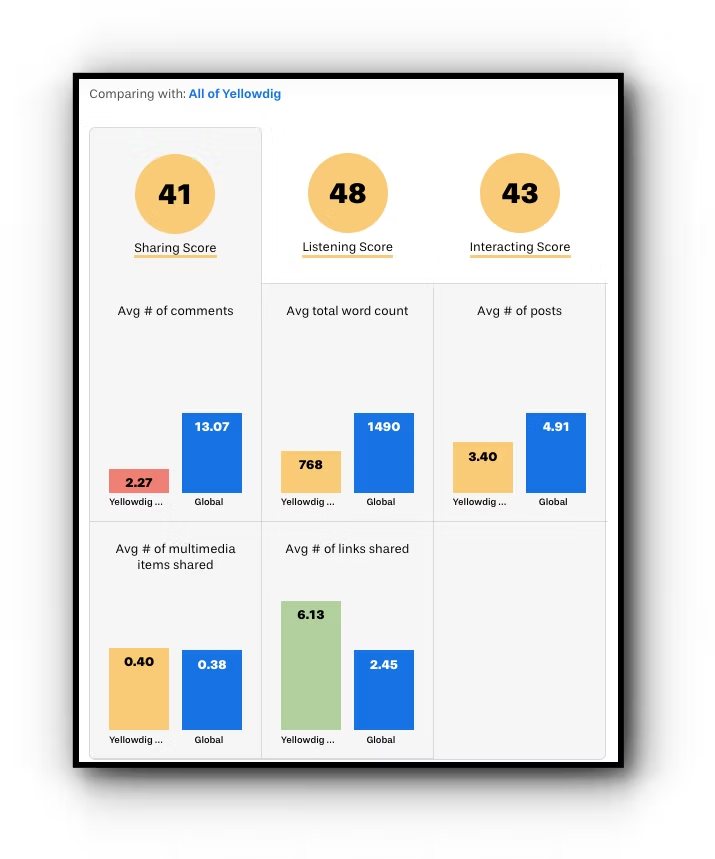
Each Yellowdig Community contains a robust data analytics dashboard for measuring and improving Community Health. Yellowdig measures Community Health along three dimensions: Sharing, Listening, and Interacting. Each dimension of Community Health is reduced to a composite percentile score that can be compared to other Communities in your Network and in all of Yellowdig. The analytics dashboard also includes an automatic best practices checker, a breakdown of Topic usage per Community Member, and a sortable Member-level activity table.
Using our suite of in-platform and on demand data analysis services, instructors and administrators can visualize usage and performance patterns, compare network-level success metrics to Yellowdig-wide metrics, identify highly successful instructors and departments, identify isolated or disengaged students, and compare students’ levels of productivity, connectivity, and attentiveness in Communities with different point settings and content strategies. These advanced analytical tools also help instructors infer correlations between recommended practices and success outcomes, identify areas of excellence and improvement in their Communities, and continue to hone their Yellowdig pedagogies.
Network, Communities, and Groups:
Our Network system is one of the hallmarks of the Engage platform and it facilitates safe and contained Community discovery, helps your administrators customize and monitor communities, organizes and enables student-run Communities, allows instructors to compare their outcomes against global outcomes and their own network, and enhances your organization’s data analysis capabilities. As subnetworks and communities are established for different purposes data is easily scoped and reported for those purposes.
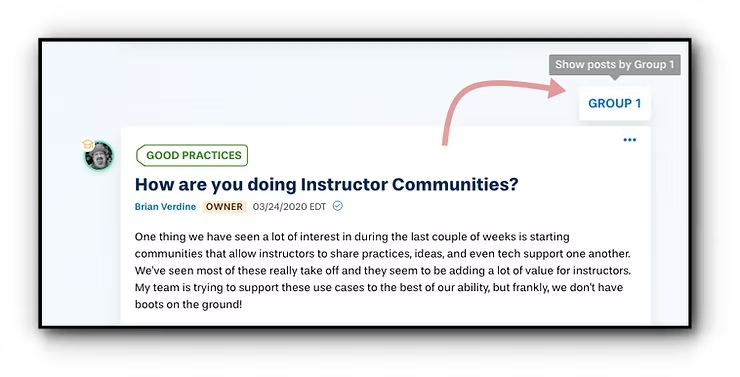
Relevant to enabling more regular and substantive interaction without the burden of additional work, in Yellowdig Communities students can be sorted into smaller groups within the same community. Visibility of those groups can be toggled on and off to allow or prevent students from seeing other groups and their content depending on course needs. Grouping can be particularly useful for very large enrollment courses or courses with multiple sections because smaller numbers of faculty and teaching assistants are able to make Posts visible to and interact with a larger group of students at one time and in one place. Meanwhile the students’ peer-to-peer experience is that of a much smaller community. These smaller communities tend to have less content to interact with but also tend to allow students to more easily build stronger peer-to-peer relationships among a more intimate subset of the class.
Multimedia posting and commenting:
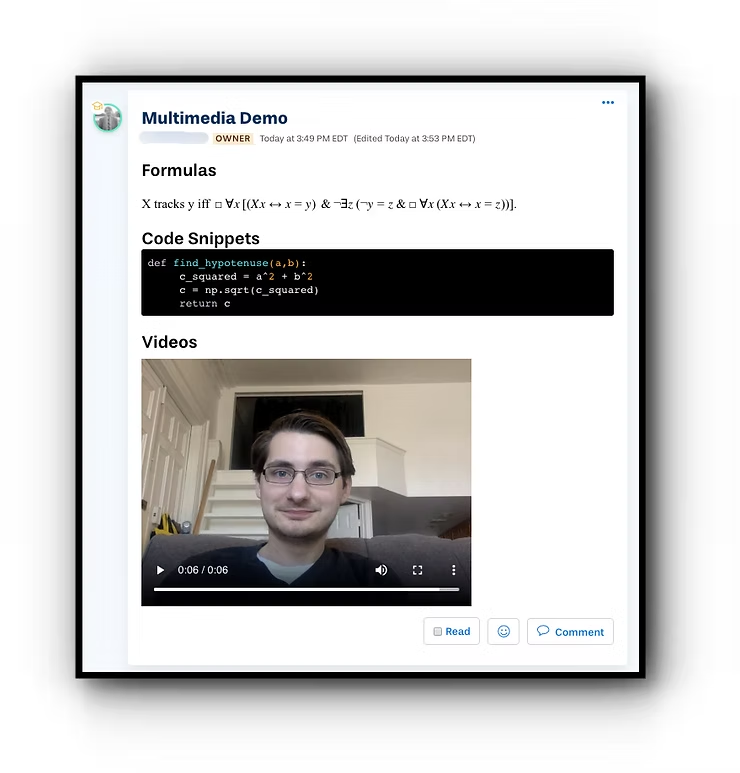
Yellowdig offers many different ways to convey knowledge and enable group and individual interactions. Users can record videos and attach them to Posts without ever leaving the platform. This feature is particularly handy for whiteboard sessions, presentations, and video self-introductions. Users can also draw diagrams and annotate on top of uploaded photos and diagrams. Finally, users can share formatted formulas and code snippets.
Direct Student-Instructor Interactions:
Aside from the ability to comment directly on a student’s post or comment, instructors have a number of tools that are useful for direct student interactions.
Instructors are able to add emoji reactions to any post, just as other students can. In addition to these reactions, they have the special ability to create and award Accolades with custom titles, icons, and point values. Accolades give students a point bonus for posting particularly interesting, helpful, or rigorous content and provide a visual indication of the acknowledgement for students to see.
Members can directly message all of their contacts in their Network. This functionality allows instructors to directly reach out to students who are isolated or disengaged from the Community or to allow shy students to reach out to instructors privately to get answers to their questions. Because the Messages feature is used outside of specific communities they also help good conversations and mentoring relationships endure well beyond the end of the term.

APIs, Reports, Custom Integration:
Yellowdig’s data capabilities are a differentiator when it comes to understanding student and instructor behavior and documenting and reporting that activity. Our partner institutions own their data and we have APIs that provide easy access to that data for any needs not covered by the in-platform capabilities. We have regularly used these data capabilities to report attendance and monitor regular and substantive interaction metrics for online programs. We have also built custom integrations with clients around the specifics of their internal tracking systems. In addition, we have a full-time Client Success Analyst that can assist with data needs and creating customized reports and visualizations to help your institution understand the value provided by Yellowdig in improving engagement and interaction.
Conclusion:
With every new trend and additional regulation aimed at ensuring student success in the online space, finding systems that meet those needs while still remaining easy for faculty and the administration to implement and use is a real challenge. Yellowdig’s technology was forged in the higher-ed space and designed to meet the unique needs of educational institutions. As new regulations emerge we respond, which is why our platform is FERPA compliant, conforms to WCAG 2.0 AA accessibility standards, and meets the high security needs of universities. We provide data capabilities that are unmatched by other systems which are necessary, at a minimum, for accreditation, attendance tracking, and these new regulations around “regular and substantive” interaction. Yellowdig is a system that is easy for faculty to implement, that engages students and faculty in a unique way that actually helps solve the engagement and retention problems of many online institutions, and that provides the kind of real-time data and insights necessary to both monitor and improve student-student and student-faculty interaction.
Shaunak Roy is founder and CEO of Yellowdig, a digital platform for active, perpetual learning allowing collaborative and immersive learning to happen. Write to: [email protected].
Brian Verdine, Ph.D. is the Head of Client Success at Yellowdig. Brian received his Ph.D. in Psychology from Vanderbilt University’s Peabody College of Education and Human Development. He went on to a postdoctoral position in the Education department at the University of Delaware where he later became, and continues to be, an Affiliated Assistant Professor. His academic research and his now primary career in educational technology has focused on understanding and improving learning outside of classrooms, in less formal learning situations. At Yellowdig he manages all aspects of Client Success with a strong focus on how implementation in classes influences instructor and student outcomes.
Samuel Kampa, Ph.D. is the Client Success Analyst at Yellowdig. Samuel received his Ph.D. in Philosophy from Fordham University. He taught seven classes and nearly 200 undergraduate students at Fordham. He brings to Yellowdig that teaching experience, an enduring interest in improving pedagogy, and data science training that has helped expand Yellowdig’s data analysis capabilities and improve instructor training materials.