

Building a community for students to learn and listen to each other is an effective approach to teaching. Gayle Fischer, history professor at Salem State University, sat down with Yellowdig in April 2021 to talk about how she uses our virtual classroom platform for her Women’s History Class. Prior to using Yellowdig, she had difficulties teaching in class with limited accommodations to her hearing. Gayle found herself withdrawing and speaking less and less with her students. “It really puts a damper on discussion,” she explains.
When the pandemic started – right around the time of their Spring Break – she found herself trying to “get as much of my material online as possible.” Students logged on to look at readings and take quizzes, not truly experiencing an active learning environment. After looking and trying out different platforms, she stumbled upon Yellowdig, and fell in love with it.
What Was Different?
When Fall semester came around, Gayle’s goal with using Yellowdig was to get some engagement and discussion going on between the students. After introducing the students to the platform, she noticed that they were easily already making themselves familiar with the social media-esque platform. Instead of the artificiality of discussion boards on Canvas, which were based on prompts and not conversations, Yellowdig “was much more organic than that.“
Students enrolled in Gayle’s class were taught asynchronously without a video conferencing platform. This provides very little room to get to know students, but through Yellowdig, she was able to get to know her students’ interests, insights, and “they became real people.” She saw that students were interacting beyond classroom material, giving each other encouraging words and advice.
Topic Tags
On top of making personal connections in the classroom, Gayle wanted to see her students make connections with the course materials to their own lives.
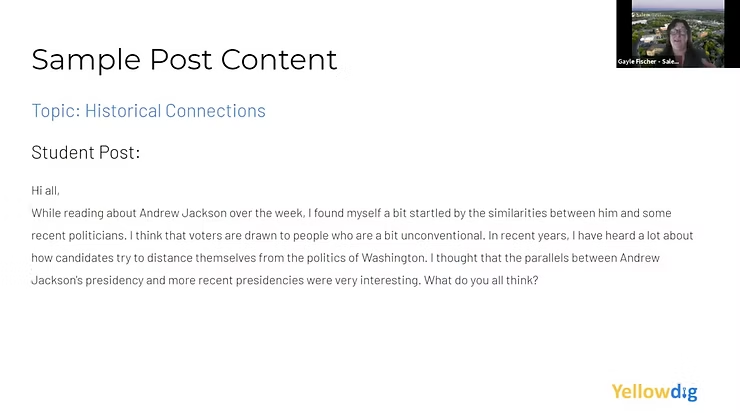
Here’s an example of a student starting a conversation using the “Historical Connections” tag that Gayle created for the class:
“I found it really interesting that we read about Ethan Allen in our text book and all I could think about was the furniture on Rt1 Saugus. I had to look it up to see if they were related and they are! This store was founded in Vermont and they talk about Ethan Allen on their page. Check it out! I wonder how many other stores are based upon historical figures? Can you think of any that are in business today?”
She explains that “often, students go in [to class], do the reading, do the homework, leave, and forget it.” With the help of Yellowdig’s topic tags, students were able to bring insights into the community while thinking about where it belongs in the course.
Point System
While using Yellowdig, Gayle also noticed how the point system incentivized students to initiate interesting conversations. In this example, this student ties in historical events with current events, generating a great deal of discussion in the post. Gayle explains, “the more people who respond to their posts, the poster gets points, as well as the writer of responses.”
Gayle explains that although participation and attendance counts for 25% of the final grade, there are always going to be students who object to it. What’s different about Yellowdig is that students find themselves posting on the platform more for the social points — comments, likes, and interactions — rather than posting something for their final grade.
Student Feedback
Gayle acknowledges that when using Canvas (her primary LMS), students tend to rely on a stricter calendar. This can lead to students feeling overwhelmed and feeling a lack of motivation, almost as if they just want to do the assignment to just get it over with ASAP.
Following Yellowdig’s best practices, Gayle didn’t impose set due dates for their assignments. Although Gayle did post reminder announcements on Canvas and personally send emails to students about posting on Yellowdig, they were not tied down by deadlines. This allowed for students to freely use the platform in the same way they used social media, and students were able to stay motivated.
Gayle herself also felt that she was part of the community as a member and not an instructor. She participated in discussions as a person who brought in alternative views and as someone who corrected misinterpretations, but “doing it in a conversational manner.” She was able to easily connect and encourage her students, and they were able to reciprocate that back to her.
Being a Professor on the Deaf Spectrum
Before the pandemic started, when Gayle was still teaching face-to-face classes, her main issue was whether or not she would be able to hear her students. “In the classroom, I haven’t had very many accommodations [for my hearing],” she explains. Her classrooms were carpeted, and the doors were near the back of the classroom to limit sound as much as possible, but those accommodations were not enough to make her feel confident in hearing students speak.
She found herself encouraging students to speak less and less. Gayle explains, “Sometimes I have to get, like, this close to students and ask them to repeat for the third time what they just said because I’m not understanding or hearing all of the sounds.”
It would get to a point where she asked students to just write down what they said. This got frustrating for both herself and her students. It was difficult to connect with them, and it was even more difficult when the pandemic started.
So, when she transitioned from in-person to online and started using Yellowdig, Gayle began to notice how her role as an instructor had changed. She found herself being a part of the community, joining in on conversations and discussions between her students as a member and not an instructor. Gayle was able to connect with her students like never before.
Role as an Instructor
After using Yellowdig through her second semester, Gayle had already started thinking about what she learned about herself as an instructor. How will she run her class again with Yellowdig? What changes are going to happen?
Yellowdig helped her realize that it is the students that determine how the platform is being used for the class. Gayles says that she loves “how much they own Yellowdig,” and although she is occasionally present to help guide discussions, most of the conversational learning comes from the students themselves. She learned that Yellowdig is a platform that is powered by students, and that as an instructor, her job is to be a part of the community and conversations that students bring onto the platform.
Watch the full webinar here for more detailed insights from Gayle Fischer: https://www.youtube.com/watch?v=mBYE5wiUPnY&ab_channel=Yellowdig