The COVID-19 pandemic reignited the debate on teaching modalities among teaching faculty, students, and parents around the world. It’s been almost 20 months since the pandemic forced schools and universities to transition to online learning, and each institution has had its fair share of triumphs and setbacks along the way. With an increasing number of students returning to brick and mortar classrooms in the Fall 2021 semester, I decided to sit down 1:1 with Bob Ertischek, J.D. to learn more about his experience with face to face learning as a former educator and how Yellowdig can be best used in this modality.
Bob Ertischek, J.D., is the Senior Academic Liaison at Yellowdig, and works with our partners to share Yellowdig best practices and pedagogy. He received his Bachelor’s degree from University at Buffalo and his Juris Doctor degree from Temple University in Philadelphia. Prior to coming to Yellowdig, Bob founded and led Profology, a professional development community for higher education instructors. He also taught political science for over a decade at Monroe Community College in Rochester, New York and worked at Rochester Institute of Technology as an instructional technologist/faculty developer where he evaluated educational technology and worked with faculty members to use online tools to increase engagement in their courses. Before transitioning to higher education, Bob practiced law in Rochester, New York.

Q: Since you taught face to face classes for over a decade, could you walk us through your experience with this modality?
A: Overall, I really enjoyed teaching face to face classes. For context, I was mostly teaching American government-related courses. I loved being physically present in the classroom, connecting with my students, learning from them, and sharing the course with them. I certainly valued being involved in helping students and interacting with them regularly, as I was able to build and nurture relationships that I still have and cherish to this day.

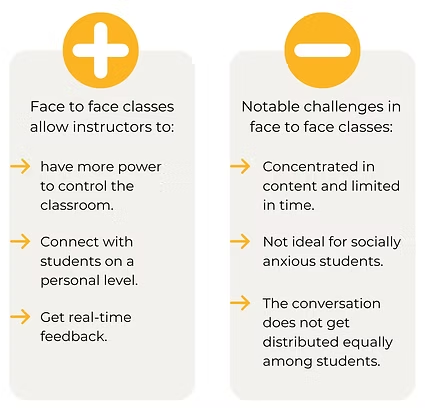
Q: How important is it to add an asynchronous element to your face to face class?
Q: How can instructors best utilize Yellowdig for face to face learning?
Also, one thing I really love about Yellowdig is that it allows the instructor to use the conversations and Yellowdig data to inform their teaching and make real-time adjustments to their class. If an instructor sees that students are avoiding a certain topic, maybe they don’t understand it and you need to cover it more. If students are asking a number of questions from something you covered a few weeks ago, maybe take a little class time to readdress that concept. As far as a participation grade goes Yellowdig gives both students and instructors a fairer assessment of their performance since everyone is compelled to participate. It eliminates the subjectivity in awarding the participation grade which tends to be tricky, especially in face to face setting.
As Bob mentioned, having an asynchronous element is an essential part of your course regardless of the modality. Transitioning back to face to face learning does not eliminate the students’ need to continue the conversation and expand on the topics discussed in class after class hours, and that’s where Yellowdig can help your students achieve academic excellence while increasing their engagement and retention rates.