January 3, 2023

How to Increase Student Success and Unlock the Door to Purposeful Lifelong Learning

Unlocking Student Motivation with Gameful Learning

Instructors everywhere face the same uphill climb: getting students to participate meaningfully—especially in online classes. Despite your best efforts, traditional discussion forums can feel more like boxes to check than places for real learning. What’s the antidote? For many educators, the answer is gameful learning.

What is Gameful Learning?

Gameful learning isn’t about turning your classroom into an arcade. It’s about applying the elements of games—clear goals, meaningful choice, and immediate feedback—to academic environments. Platforms like Yellowdig use points, badges, and accolades to recognize real contributions, making participation feel rewarding, not obligatory.

Why Gameful Elements Spark Engagement

Why do students respond so well to this approach? Because gameful mechanics tap into motivation in ways that rote assignments can’t. When students earn points for thoughtful posts or insightful replies, they're encouraged to dig deeper and share experiences. A little friendly competition doesn’t hurt, either—leaderboards spark engagement and help shy students ease into participation.

Yellowdig’s Approach: More Than Just Points

Yellowdig’s platform is built around the idea that engagement should be authentic, not forced. Points aren’t given for empty “I agree” comments, but for contributions that spark conversation and critical thinking. Students can curate their posts with articles or videos that interest them and receive recognition when others interact with their content. This approach fosters intrinsic motivation—students participate because they want to, not because they have to.

Real Results in Real Classrooms

Instructors using Yellowdig consistently report stronger participation and deeper discussion. One faculty member noted that “seventy-five percent of student questions get answered by their peers,” freeing up their time to tackle more advanced topics. Students say they look forward to checking new posts, sharing resources, and earning recognition for meaningful contributions.

Tips for Making Gameful Learning Work

  1. Set Clear Expectations: Let students know how points are earned and celebrate thoughtful interaction, not just frequency.
  2. Offer Meaningful Feedback: Use accolades and comments to highlight particularly insightful posts.
  3. Encourage Creativity: Remind students they can use links, visuals, or even short videos to make their posts stand out.
  4. Foster Healthy Competition: Leaderboards and weekly challenges can energize participation and keep momentum going.

The Takeaway

Gameful learning turns participation from a chore into an opportunity for discovery and community. With the right design, recognition, and tools, you’ll see students take more ownership of their learning—unlocking not just better engagement, but genuine excitement for the subject.
Ready to see how gameful learning can transform your course? Try out Yellowdig and join a thriving community that believes learning should be as rewarding as it is rigorous.

The assessment of prior experiential learning began to go mainstream in the early 1970’s with the creation of CAEL, led by Dr. Morris Keeton. Today, after more than 50 years of collecting information and conducting research on the assessment of prior learning, we know that experiential learning, as well as other learning done outside of academic circles, has substantive and extensive academic and occupational value. In other words, we have proved that learning is ongoing and lifelong, as well as multi-dimensional, regardless of historic academic bias to the contrary.
In the process of learning how to assess experiential learning, we discovered the value of reflection; that, yes, the process of reflecting on past learning identifies and validates personal, academic, and occupational “knowledge”. But it also identifies and values two other dimensions of learning and its employment in real life: cross-cutting critical thinking abilities as well as personal behavioral traits. Disciplined reflection strengthens the ability of the learner to become an active lifelong learner with the ability to identify learning in life events. As an early graduate of the Community College of Vermont (CCV) told me, “I appreciate the degree. But really, thanks for the assessment program. Now I know that I am a learner and that I’ll never stop learning!” 
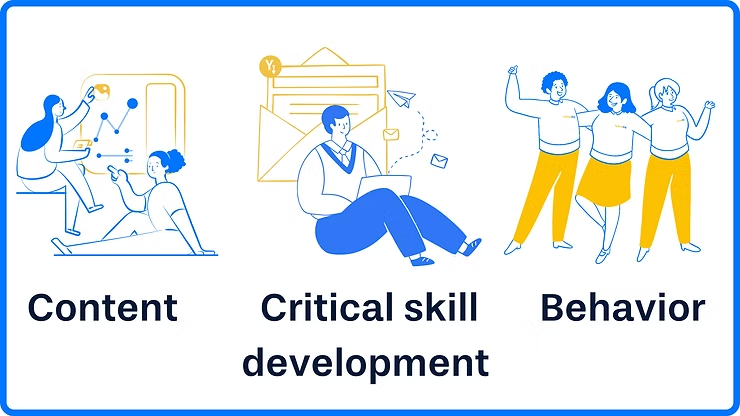
Over the years, I have come to understand and recognize that reflection is the process of extracting meaning from your lived experience. Learning to reflect, and being actively encouraged and rewarded for doing so in an organized and dynamic learning community, sows the seeds for becoming a lifelong learner. It strengthens and deepens all three dimensions of learning: content, critical skill development, and behavior. When an institution encourages all three of these dimensions, it enhances its ultimate value to the learner, the institution, and society at large.

Currently, critics of higher education are questioning its value as the main pathway to good jobs and a productive social, civic, and economic life. The latest term for this critique is “the paper ceiling”. College takes too much time and is too unproductive for too much money, the argument goes. And for other learners, a lack of respect for their life and cultural experiences as well as their natural talent, when combined with the other negatives, is also a significant obstacle. Colleges expand the value proposition when they deepen the learning and harness that natural talent to enhance performance. The objective should be to turn classroom learning in the traditional format into a three-dimensional experiential learning event. This can happen by creating a learning community in a dynamic environment where participants can explore points of view, perspectives, and proposed employment of knowledge in an ongoing discussion with others. This approach encourages and integrates the classic, but informal student discussions that previously may have occurred spontaneously in the student union or in a Friday night dorm discussion in a special, data-driven, and more formal way.

More specifically, learning events supported and enhanced through Yellowdig Engage are three-dimensional. The process reinforces and encourages content acquisition (learning something that can be known and applied), cross-cutting critical thinking abilities (applying knowledge in response to a life situation through critical thinking, problem-solving, or analytical thinking), and behavior (doing so effectively given the situation in which the experience is occurring). 
By understanding and encouraging these three domains of experiential learning, this approach fosters reflection through engagement and dynamic exploration of topics pertinent to specific course objectives, whatever they may be. It also improves completion and success rates by eight per cent or more, while significantly improving the quality and multi-dimensional aspects of learning as well, thus enhancing the learner’s life-long learning capacity.

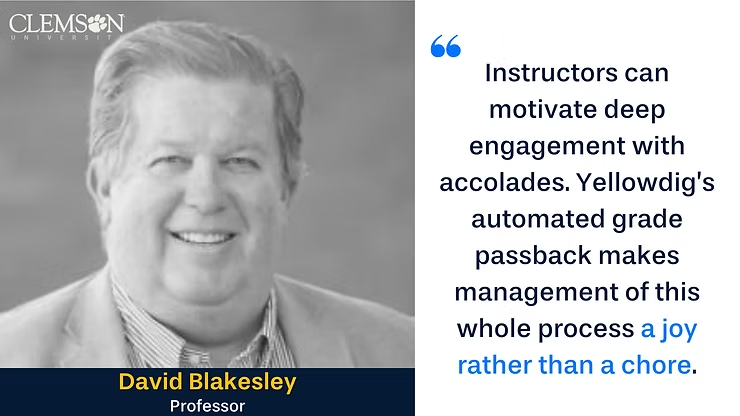
There are two other characteristics which enrich the actual participation and climate in a course. First, learners should be able to bring other, related information and articles to the conversations; to share articles, blogs, and videos from courses and sources to augment their understanding, make a point, or simply to share for the benefit of the class. This helps to integrate what they are learning into their current life and the world around them. For example, during the Covid pandemic, healthcare-oriented courses might also discuss the COVID virus, vaccines, and public policy. As the pace of innovation grows, this would become an excellent way for folks to remain relevant and current, as course refresh often takes years. Second, a lot of instructors tell us that Yellowdig not only saves them “course-management time”, but that the gameful learning environment motivates learners to participate and also makes their experience more positive and joyful.
Finally, the use of technology in creating this learning environment is both unique and multi-faceted as well. First, it relies on a consistent platform/AI construction and process in which faculty are trained. This creates a level of consistency across multiple sections and different subject matter fields that would have been impossible to attain previously. Second, it must generate data that allows the faculty member to evaluate participation and performance without directing or dominating the discussion. In doing so, it establishes the basis for including the discussions in the overall course evaluation, thus encouraging and rewarding active and sustained learner participation and engagement. Yellowdig brings a model for achieving this learning environment.  

Let’s call it the Yellowdig trifecta: increased retention, deeper learning, and developing lifelong learning skills through reflection. And, on top of all that, it is more fun!

Just two years after earning his Bachelor of Arts from Princeton University in 1968, Peter Smith led the effort to design and establish The Community College of Vermont, now entering its 53 rd year of operations.

He also served as founding president of California State University Monterey Bay from 1995 to 2005. Smith was responsible for building the university and guiding it through all stages of accreditation while raising nearly $100 million externally to academic buildings and programs.

After leaving Cal State Monterey Bay in 2005, Smith served as Assistant Director General for Education for the United Nations Educational, Scientific, and Cultural Organization in Paris, France where he was responsible for more than 700 staff located in 30 countries.

Smith also served as Dean of the George Washington University Graduate School of Education and Human Development from 1991 to 1994 after serving his home state of Vermont as a state senator (1980-82), Lt. Governor (1982-86) and Congressman-at-Large. (1989-1990)

Smith currently serves on the following Boards

  • National Center for Higher Education Management Systems

  • National Council – State Authorization and Regulatory Authority

  • DEAC National Board

  • Association of Governing Boards – Senior Fellow

Keep reading
Yellowdig
Want a Yellowdig Community that doesn’t suck? Follow our best practices.

In 2020, we created a composite Community Health metric that captures four key dimensions of student engagement and achievement. Along the way, we confirmed something we already knew: instructors who use many of our best practices have Communities that perform significantly better than instructors who use fewer. Over the past 3 years, we’ve continued to […]

Product Updates
Yellowdig Engage Product Update 2/19

Features: Password complexity checking. This strengthens the security of users’ accounts. Post reply-to threading UI. This distinguishes replies to comments from replies to posts, making it easier to read and track long conversations. Avatar hover card. This allows users to follow and directly message each other by hovering over their picture in the feed. Interactive […]

Student Success
The Textbook’s Crumbling Monopoly

But that is no longer the case today. The textbook’s monopoly on knowledge is crumbling (if it hasn’t already). Scan any university campus or peek in on any dorm room and you will see fewer books. Why? Well aside from the astronomically inflated cost of textbooks at campus bookstores, the model in which students acquire […]

See Yellowdig in Action Today

Experience how effortless engagement and real community can transform your classroom or campus. Book your personalized walkthrough—no pressure, just real results.