
In my face-to-face classes, I’d look around the classroom and try to intuit whether or not my students “got” what I was talking about by asking pointed questions, listening to the responses of the one or two students I had time to call on, and then looking for glimmers of recognition in the eyes of everyone else. I had to take this very limited feedback to adjust and decide whether or not to spend any more time on a particular subject. The feedback I received from assignments, tests, and quizzes came too late to be of much use. How I wish I had been able to use Yellowdig to give me a much better sense of how all of my students were relating to the material.
I taught for over a decade before coming to Yellowdig, and during that time, I tried all kinds of things to expand the time I had with students beyond the 50 minutes 3 times a week, or the hour and 20 minutes, twice a week that I had with them. Even though my classes had a great deal of interaction, I always felt like we never had enough time to dive deeper into what students found interesting or to allow all of them to have full-throated conversations about what we were discussing.

Even though I’m no longer in the classroom, I can share how you can use Yellowdig to find what subject matter your students are finding most interesting and engaging and perhaps what material you might want to spend a bit more time on with them, as well. In case you don’t know Yellowdig yet, it’s a secure, asynchronous, organic student engagement engine with proven results. Its paradigm-shifting approach to online discussions and community can increase student engagement in ways that tools like Zoom and learning management system discussion boards can’t begin to approach…and it can inform teaching and reduce instructor time investment in discussions.
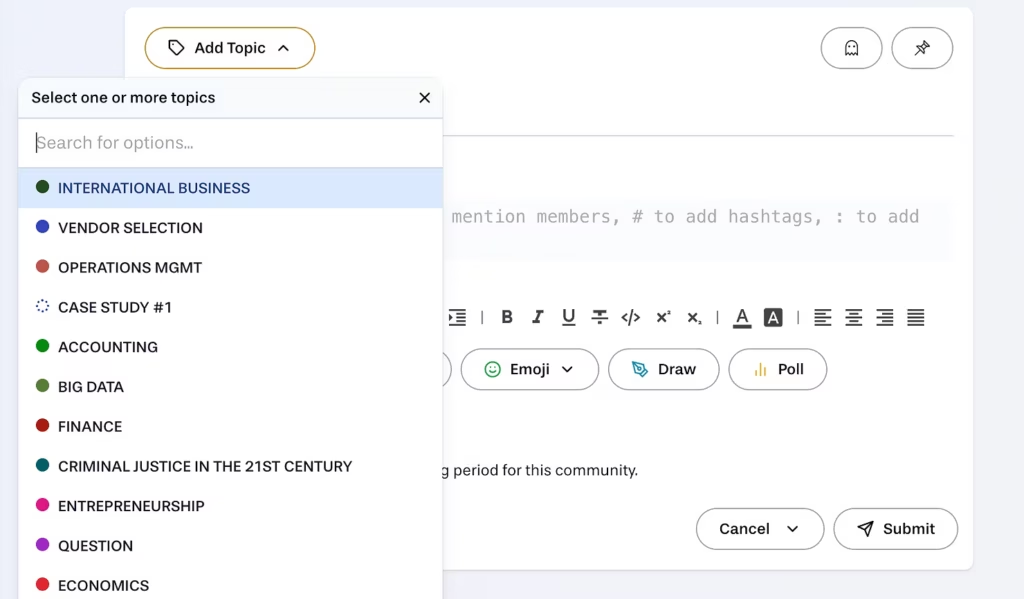
Yellowdig allows you, as the instructor, to look behind the scenes and find out what subject matter your students are interacting with and where they are spending less time. This is feedback you can use to adjust your teaching. It’s pretty simple. When you create your Yellowdig community, you can create topics that align with your top-level syllabus subject matter. Then, when students post, they will be prompted to add a topic tag reflecting that subject matter along with their post.
3 ways using topics during your virtual classroom setup will improve yours and your students’ experience:
First, it makes tracking conversations much easier. Once tagged with the appropriate topic, you and your students can simply click on the topic tag to easily filter the Yellowdig feed to show only posts with that topic.
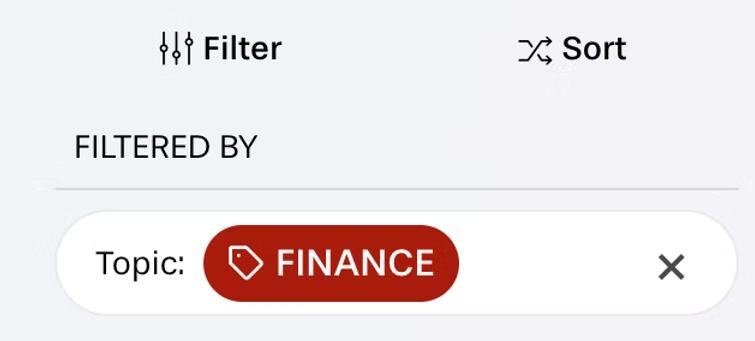
Second, when requiring students to add topic tags to a post, it forces them to think about why they are bringing in that particular item and where it really belongs inside the virtual classroom, relative to your course.
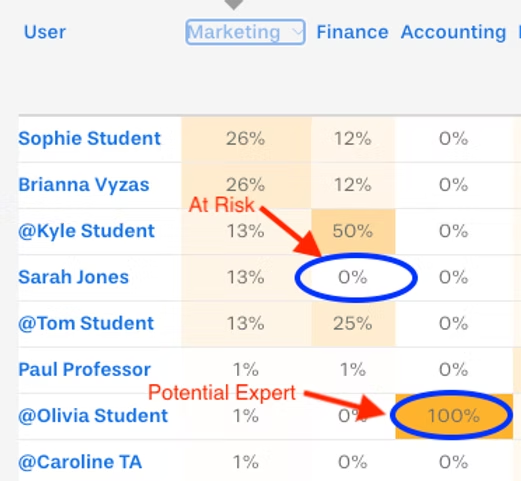
And third, as I’ve said before, using these topic tags can show you what is of interest to your students and it can inform your teaching. Engagement with topics is tracked in the Yellowdig Community Health dashboard. When you enter the topic area, you can see a global view of which topics students interacted with and to what extent.
You can also see how individual students are interacting with each topic, pointing out your student experts, and acting as an early warning system for those students who aren’t engaging on that particular topic.
Leveraging Topics is a powerful way that Yellowdig can help you create relevance and engagement allowing conversations to ebb and flow as the subject matter becomes relevant and important to students. Yellowdig Topics force students to think a little more about what they bring into your community and where it belongs. Finally, Yellowdig Topics inform you about where you may need to spend more time and where you can move on.
Bob Ertischek is is the Academic Lead at Yellowdig, a U.S. company dedicated to creating communities where social interaction and learning build the relationships and skills that allow people to thrive. In this role, he works with partners to share best practices for creating community and meaningful student engagement. Prior to coming to Yellowdig, Bob founded and led Profology, a professional development community for higher education instructors. He also taught political science for over a decade at Monroe Community College in Rochester, New York. At Rochester Institute of Technology, he served as an instructional technologist/faculty developer, here, he evaluated educational technology and worked with faculty members to use online tools to increase engagement in their courses.
Want to talk Topics with me? Send me an email at [email protected]!