I was in a conversation with one of our partners, a senior administrator responsible for institutional effectiveness. There is significant focus on retention, and as a result, on student belonging. They are doing an amazing job, but even a 1% lift is sizable—both for student success and the financial bottom line.
What got me thinking is that retention is often lagging indicators. We know when the withdrawal form is submitted, when there’s an advising no-show, or when a student simply drops out. How can we shift our focus to leading indicators—and when exactly should we intervene to retain a student before the decision is quietly made?
This is not theoretical. It’s a question we need to answer to build the right solution and student support infrastructure.
What we decided to do was randomly select a sizable number of communities to get a more informed answer. To make it measurable, we defined a Belonging Index (IBI) from 0 to 100:
- Community Coverage — what share of their cohort each student actually interacts with
- Conversation Ratio — depth of dialogue, not just volume of posts
- Mention and Reaction Density — whether students are publicly acknowledged by peers
- Cross-Group Interaction — whether students connect across disciplines and backgrounds across multiple communities
This measure could be improved, but it’s a good starting point.
The pattern shows up in Weeks 6 through 9 of the semester—quietly—while the participation dashboard is still green. It looks like a student who is still posting, still submitting, still technically present. But they have stopped being part of the community. They’ve retreated to a circle of 2–3 comfortable peers. They are invisible to 75% of their cohort. And they are making the decision to leave—weeks before they file for withdrawal, weeks before any academic signal fires.
We can measure this now. And the pattern is consistent enough across institutions that it has real implications for how universities are run.
The Arc
The semester-long belonging pattern was remarkably consistent across institution type, discipline, and course size.

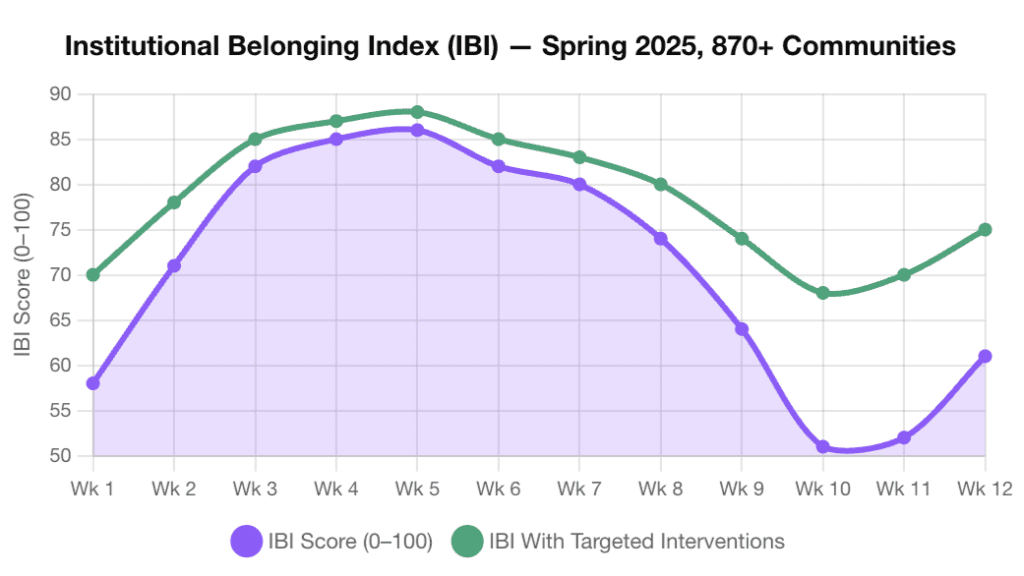
Belonging rises sharply through Week 5. It erodes quietly through Weeks 6–8. It falls off a cliff in Weeks 9–10, where the average IBI hits 51 out of 100—below the midpoint—before a partial end-of-semester recovery.
That cliff at Week 10 coincides almost precisely with peak attrition risk. It is not a coincidence.
The Finding That Should Change How You Operate
During Weeks 6–8, raw reply volume—the number of comments per post—actually rises. Students are replying more than ever. By conventional engagement metrics, this period looks like the healthiest of the semester.

But Community Coverage, peer acknowledgment, and cross-group connection are all falling. Students have found their 2–3 comfortable peers and stopped expanding. The community is collapsing inward while the participation dashboard shows green.
If your data systems only surface activity volume, you are structurally blind to the most consequential shift in the student experience. You are seeing the conversation. You are missing the belonging.
What Students Are Actually Saying
The numbers describe behavior. Student language describes emotion. Three words tell the whole story.
Week 1: “Nervous.” The dominant word in first-week posts—surrounded by “hope,” “excited,” “not sure.” Students are testing the community before committing to it. If their first posts are met with silence, many quietly conclude this is not a place for them. They don’t announce it. They simply become less present over the following eight weeks.
Week 3: “We.” The most significant linguistic shift of the semester. Posts shift from “I” to “we,” “our cohort,” “this community.” A shared identity has formed. This is precisely when the IBI peaks. The two are measuring the same thing from different angles. And most instructors don’t know it’s happening.
Week 9: “Overwhelmed.” Language becomes raw—“behind,” “trying,” “honestly.” Students stop performing and start disclosing. But the highest-risk students aren’t even saying “overwhelmed.” They’ve gone silent entirely. Silence in Week 9 is the withdrawal decision in progress.
The intervention logic follows directly: respond to “nervous” with guaranteed acknowledgment, protect the “we” moment before it closes, and treat Week 9 silence as a crisis signal—not a passive observation.
What the Data Says About When to Act
Most retention interventions are triggered by academic signals: a missed assignment, a failing grade, a formal withdrawal inquiry. By those moments, the belonging decision has already been made—typically 3 to 4 weeks earlier.
Research published in Inside Higher Ed (January 2026), drawing on data from more than 21,000 students, found that even modest gains in sense of belonging measurably increased graduation probability. The behavioral data we analyzed shows exactly when that belonging is being lost—and it is not when GPA drops. It is when Community Coverage starts falling in Week 6 and nobody notices.
The gap between the actual IBI arc and what is achievable with targeted intervention is not large. It does not require new technology or significant budget. It requires knowing when belonging is being lost—and having a response ready.
Phase Breakdown
1–2 | Students present but invisible What works: Personal acknowledgment; identity prompts over logistics prompts
3–5 | All four components align — 3 weeks only What works: Name the “we” shift; peer-to-peer prompts; protect this window
6–8 | Hidden erosion What works: “Expand your circle” interventions; reaction campaigns; faculty visibility
9–10 | Cliff What works: Specific personal outreach; peer accountability; normalize struggle
11–12 | Rally What works: Legacy framing; peer gratitude; forward continuity to next term
Three Things That Follow for Senior Leadership
Belonging metrics belong in the institutional dashboard. Community Coverage and peer acknowledgment data are not just metrics for learning experience teams. They are leading indicators of retention outcomes that should sit alongside GPA distribution and advising engagement in every provost’s weekly review. If you cannot see belonging, you cannot manage it.
Your intervention window is earlier than you think. Weeks 6–9—not Weeks 10–11—are when belonging is being decided. Early warning systems built entirely on academic performance signals operate with a structural lag of 3–4 weeks behind the actual student decision timeline. Integrating belonging data into at-risk models closes that lag.
Faculty are the belonging infrastructure. Not counselors. Not technology. Not retention specialists. The instructor who personally acknowledges a student’s first post in Week 1, who names the “we” shift in Week 3, who sends a specific personal message in Week 9—that instructor is doing the highest-return retention work in the institution. Training and recognizing that work is a strategic investment, not a professional development line item.
Belonging is not a feeling that happens to students. It is a pattern that institutions create—or fail to create—through thousands of small design decisions made before the semester begins and across each of its twelve weeks.
The arc is predictable. The interventions are known. The data is real.
The question for every senior leader reading this is straightforward: does your institution know, right now, where each of its student communities is on this arc—and what happens next if nobody acts?
If you would like to do a similar analysis with your own institutional data, we have a new tool that can help – please reach out to our partnerships team [email protected] to see a demo.