In August 2020, I wrote the blog “Is BigTech About to Take Over Higher Education?”. At that time we were in the beginning phases of the COVID pandemic, and the importance of technology in education was becoming more evident as the entire world had moved from in-person to online learning. Since then we have been fortunate enough to work as an educational company with hundreds of different academic institutions from all over the world. We have helped large public institutions, private institutions, for-profits, community colleges, K-12 schools, and corporate learning programs navigate through and thrive during the pandemic. As some of the dust settles from the last few years, it is a good time to take account of what we have learned and how it might shape the future.
Although there have been many lessons learned, if there is one that stands out it is the sheer perseverance of academic institutions to weather the perfect storm that was this pandemic. Yes, our industry has experienced ups and downs, but largely higher education has remained intact. This shatters a common misconception that academic institutions cannot change rapidly. It also makes it increasingly likely that the institutions of today will continue to have a role in shaping education.
Abraham Lincoln put it best: “The best way to predict your future is to create it.” Given the massive amount of change the education industry is going through, it is clear that the future is being built right now. In this blog post, I present some of the key insights we have garnered in collaboration with our partner institutions over the last several years to present a connected learning model. My hope is that some of these ideas will inspire others in the industry to join us in the movement to create a better, more connected learning experience for students around the world. We have coined a new term for this future – Education 3.0.
What is Education 3.0?
Education 1.0
Education 1.0 emerged out of the industrial era and still represents the operating models of some academic institutions operating today. These institutions were primarily built to cater to the industrial era job market and this model served the world well for quite a long time. Education in this model is primarily in-person, offered over 2 to 6 years, with a stage-gate-like process for the students as they earn credentials and degrees. This one-size-fits-all model was dominant for centuries but is increasingly under pressure due to rapidly rising costs and preserved exclusivity from a limited supply.
Education 2.0
Education 2.0 emerged over the past 20 years or so, as many institutions started to offer online programs, distance education, and evening & weekend classes. These programs are able to reach previously underserved, and unserved populations. Although technology has improved and online/distant offerings have helped to reduce cost and improve access to education, the core learning experience remained largely unchanged. Many online programs have simply replicated traditional learning design approaches via online modalities, and often these new programs were offered separately from their traditional programs. Each student was either an on-ground or remote student and with few exceptions institutions successfully offered an end-to-end experience that successfully blended these worlds.
Education 3.0
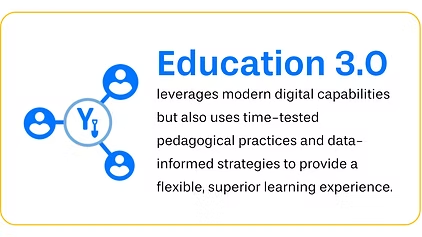
Education 3.0 is a future bringing the best of 1.0 and 2.0 together, along with purpose-built new technologies, to create a connected learning experience using the most effective tactics from both worlds. Education 3.0 leverages modern digital capabilities but also uses time-tested pedagogical practices and data-informed strategies to provide a flexible, superior learning experience. Instead of forcing learners to fit into pre-defined boxes created by rigid institutions, Education 3.0 is where institutions empower students by strategically thinking about the needs of the modern learner, the workforce they’re entering, the ways to make learning more relevant to them, and how to meet their need to connect with their peers and resources in a modern way. This future does not try to replace instructors, the challenge and rigor of a well-designed course, or the proven methods that contribute to quality education. Rather, we work together to enhance all aspects of the experience by using the best tools and practices that allow learning to happen continuously, at any time, and from anywhere.
A more holistic learning experience
The digitization of the academy is sometimes compared with Amazon’s impact on retail, or Netflix’s impact on the media industry. As I addressed in my previous blog, I feel this is a myopic view. Tech alone is not the answer to making education better or more affordable. That is because learners are not mere consumers of information. Rather they are humans, with agency, who are looking to build skills, habits, and practices for holistic development. The Education 3.0 era that we envision blends the true mission of the academy with modern technology to humanize education while also scaling its impact and availability to create a connected learning experience. My hope is that we can work toward creating a golden era for educators. Giving institutions the opportunity to finally be able to impact learners around the world, many of which were previously excluded from the academy.
A more inclusive, flexible, and technologically driven future of education might sound compelling, but to succeed in building it will require our industry to come together, learn from one another, and work together. No one institution or company can figure it all out alone. The following section addresses the challenges we face and a plan for achieving this future based on our learning over the past few years.
What are prospective students looking for?
Modern learners are not the same as they used to be and have been undergoing a gradual change over the past decade. The traditional higher-education learner base, which are students who recently graduated from high school, is shrinking in the US and will continue to fall. The upcoming “demographic cliff” means we can expect up to a 15 percent drop in freshman prospects beginning in 2025. This cliff is due to the decline in the birth rate in the 2008 recession and will last for years after. Meanwhile, the rising cost of education is simply out of reach for many families and new enrollments are already starting to decline as they look for alternatives. The good news is that there has been growth in non-traditional working-age learners who are increasingly looking for formal education to upskill/re-skill themselves. However, this group is not going to be satisfied with a traditional education experience and is eager for alternative options. They are value-conscious and looking for programs that can help them apply their knowledge in a new field. Although I haven’t seen any specific data on it, it is not hard to imagine that even traditional students, who face a dynamic and competitive job market as soon as they graduate, will also increase demand for more options and flexibility from their institutions.

Gone are the days when an institution can rest on its laurels of past success. A student-first approach is not just nice to have, but an absolute must-have going forward. Colleges and universities have a vast network of capable people, decades of experience, and public trust to be able to deliver value over a long period of time. What we will see institutions start to shift their focus to is “re-imagining the learning experience”, to something that is compelling, continuous, data-informed, and caters to the skills and experiences valued by the dynamic job market.
Designing for Education 3.0 - Connected, Compelling, Data-Informed Learning
The Importance of a Holistic Learning Experience
To effectively compete in this new world order, institutions need to focus on their core mission – provisioning a superior learning experience for the holistic development of the learner. The traditional learning experience, from admission to graduation, is typically designed around a collection of courses, student support services, and academic units. Each course is designed around a collection of modules, assignments, and exams. As a result, the learning experience is optimized for the delivery of knowledge, but not for deeper engagement, learning, and application to the real world. Employers are increasingly valuing work-ready skills as our economy continues to evolve rapidly. The Association of American Colleges and Universities 2021 Survey reveals that Employers continue to find high value in students developing a “broad skill base that can be applied across a range of contexts”. Broad-based abilities, such as the “ability to work effectively in teams”, “critical thinking skills”, and “ability to analyze and interpret data” rank high on their needs. The answer to building these types of skills is not offering yet another course, but rather incorporating opportunities to build these skills into the existing learning experience via intentional course and program design.
Amanda Antico, founder and CEO of EvolveED shares, “There’s going to be a sea change coming…the scalability of this peer-to-peer modeling is going to be one of the most fascinating things we’ve seen in the last two decades in this space and because the world is moving more quickly we’ve got to make sure the upskills that are happening inside of the corporate environments are attuned to that.”
For a learning experience to include the kinds of opportunities needed to develop these skills and meet the holistic needs of a student the experience must be Connected, Compelling, and Data-Informed.

A Connected Learning Experience
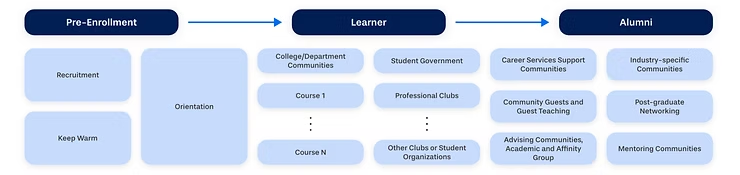
Well-designed, connected learning environments will integrate students immediately into a learning community where they become an increasingly important part of the social fabric of their institution. Moving seamlessly between experiences before, during, and after their classes, they will have a wide range of learning opportunities constantly available to them. They will also have access to support services, instructors, and fellow students that can help them at any time. As they progress through this well-connected and continuous learning experience they will have the ability to grow into leaders of their learning community, eventually emerging as engaged, successful alumni.
These types of connected learning environments not only improve student engagement and satisfaction but lead to higher retention and positive long-term association with the program. We have done a number of studies in this area and have seen up to a 15% increase in retention through a well-designed connected learning experience.
A Compelling Learning Experience
Learning spaces tend to be designed around content, without the necessary strategies to help students build context and connections around that content. The mere consumption of content is akin to sitting in a large classroom and listening to a teacher, which can lead to short-term content recall but often doesn’t lead to deep, meaningful learning.
A compelling learning experience engages learners authentically, relates to their lives, and creates a lasting impression that can be connected to other knowledge and ideas. An intentional design to create a vibrant course community enables learners to humanize the content, discuss diverse points of view, complement real-world examples, personal interest, peer feedback, and salutation/case studies helps to contextualize the content for the connected learners and produce meaningful contributions for the class.
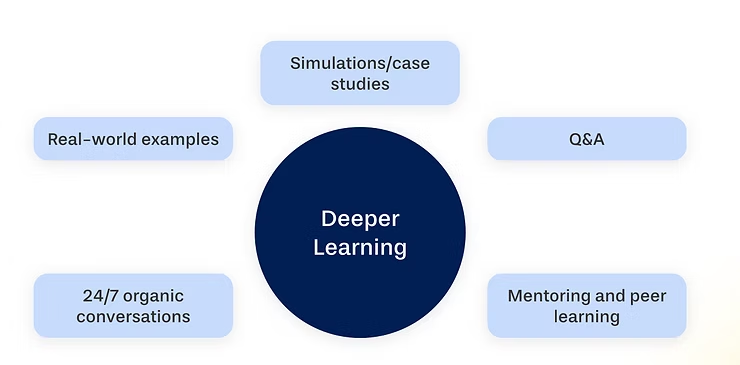
An anonymous Drexel University student shares their thoughts about their experience in Yellowdig’s learning community, “Here I was able to read various articles shared by other students, their thoughts and opinions over a topic and perhaps even some constructive criticism for some of my posts…In Yellowdig my peers seemed more engaged and the content was way more relevant since we had the freedom to talk about topics that genuinely interested us.” From young people in early education to returning students after a long career, everyone has experience with using social media to form social connections, so Yellowdig communities interaction comes naturally.
A Data-informed Learning Experience
Most reputable education is designed around outcome data, such as grades, pass or fail. What if we evaluated effort, interest, and behavioral data that could inform success outcomes just as often? Most at-risk students don’t complete courses and drop out for various reasons, sometimes even before starting a new program. What if the learning experience design started by connecting the learners to resources available to them, and to each other before they even start taking their courses? In that case, data collected during that time can provide actionable insights into their behavior, especially at-risk students. The key is to collect activity and behavioral data, and develop a model of student actions that predict students at risk of dropping out or performing poorly. Using AI and data science, this model data can be used to analyze academic performance outside of grades, such as communication, leadership, influence, and critical thinking skills. This analysis can inform the re-design and upgrading of courses and programs based on actual student needs and engagement in addition to the less traceable qualitative feedback gathered after a course or program ends.
Measuring the Impact of an Education 3.0 Learning Experience
We have summarized some of our insights into the impact of community-based learning from surveys and studies conducted in the past few years by the Yellowdig team and our institutional partners.
What have we seen? Firstly, students are more satisfied with a connected learning experience as they feel more supported in their individual learning journeys. Improved social connection with their peers leads to deeper learning, meaningful relationships, and academic support they can call on whenever it’s needed.
Sabrina P., a Neuroscience student at Hofstra University shares, “Yellowdig makes asynchronous courses more enjoyable. From my personal experience, Yellowdig has made me want to go out of my way to post on my class forum and engage with fellow peers frequently.”
Secondly, the majority of instructors report a more enjoyable and energized teaching experience as they feel more in touch with their students, and are able to influence their learning outcomes. Instructors also reported a substantial reduction of time spent answering routine questions as learners tend to help each other.
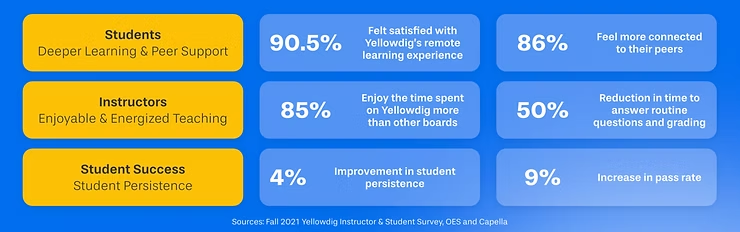
Finally, institutions that have adopted us at scale have reported substantial improvements in persistence and increased pass rate. This directly impacts the bottom line, as it retains students and tuition dollars, especially as the cost of student acquisition grows.
It is important to note that these are based on studies with institutions and instructors that have volunteered to do studies with Yellowdig data, which is indicative of the potential of this space. We would like to collaborate with any school that wants to study these areas of impact with us.
How does an institution fund Education 3.0 initiatives as budgets become increasingly tightened?
Firstly, if done right, implementing a connected learning experience is far less expensive than other retention initiatives that institutions often undertake. Working with a partner in the space with a proven track record minimizes the downside risks, and can help with quickly testing if a solution is delivering the promised results through a carefully designed pilot.
Secondly, the time to Return-On-Investment (ROI) is usually short, often within months of implementing such solutions in practice. For example, an institution with 5000 learners, $10,000 average tuition, and a 25% attrition rate loses $12.5M per year in tuition fees, not counting the added marketing costs for recruiting additional students.
If you assume an institution spends $500,000 per year implementing and maintaining a solution that improves persistence by 6%, then total tuition savings is $6M with an ROI of 12X for the solution. Although these numbers are examples, it is not hard to see how even a small percentage improvement in persistence that also delivers better learning outcomes on an ongoing basis is a big win-win.
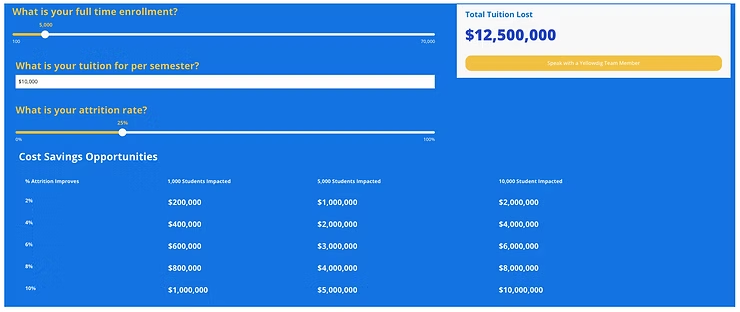
Finally, as recruiting students is increasingly becoming expensive outside of the most elite institutions, creating a positive learning environment and retaining existing students is becoming a must-have to remain competitive. As the total number of learners is finite, institutions that make these investments early will easily edge their way into leading positions in the market.
Looking forward
This blog post presents our current understanding of how Education 3.0 is unfolding. In the next few years, the world around us will continue to evolve rapidly, as does the technology and regulatory landscape that we operate within. As we continue on our journey, we look forward to collaborating with institutional leaders, think tanks, researchers, and our peer companies to work towards creating this improved future of education.
—————–
Blog contributors:
Author: Shaunak Roy, Founder and CEO of Yellowdig. Shaunak is the founder and CEO of Yellowdig. Yellowdig is a community-driven active learning platform adopted by over 130 colleges and universities, K12 schools, and corporate training clients.Yellowdig’s mission is to transform every classroom into an active, social, and experiential learning community. Shaunak graduated with a degree in mechanical engineering from IIT Bombay and completed his graduate studies at the Massachusetts Institute of Technology. Prior to founding Yellowdig, Shaunak spent a decade advising global companies on technology, strategy, and growth.
Some of the above ideas came from advisory sessions with Yellowdig advisors and board members. Special thanks to Mark Milliron, Dave Daniels, and Cathy Casserly among others in our distinguished advisory group.
Edited by Brian Verdine and Brianna Bannach.