
The world of education has come a long way with new methods of teaching and learning arising as years progress. In particular, the increase in different education technologies has had a significant impact in how content is delivered in the classroom.
Shaunak Roy, CEO of Yellowdig, and Brian Hurlow, Director of Technology, sat down to discuss how the idea of student engagement has transformed beyond the in-person classroom to meet the needs of all students and faculty, resulting in increased retention.
Early Days at Yellowdig
Yellowdig was created by Shaunak Roy to bridge the gap between knowledge delivery and engagement. After moving to the U.S. from India to pursue his studies, another passion was beginning to ignite itself in Shaunak’s mind. Growing up with a family that valued education, he found himself also striving to improve the learning sphere so that others can see the true significance of learning. Yellowdig came to be because Shaunak wanted to build a product that would help students want to learn and enjoy learning.
Brian Hurlow, the brain behind the architecture of Yellowdig’s virtual classroom platform, was a Political Science major at MacAlester College, but he actually found himself writing code most of the time instead. After graduation, he pursued coding by continuing to build technology. He has had many experiences that made him realize that things could have been better than the status quo in online education, and began helping Shaunak create Yellowdig as a learning tool for students and instructors to connect in a unique and organic way.
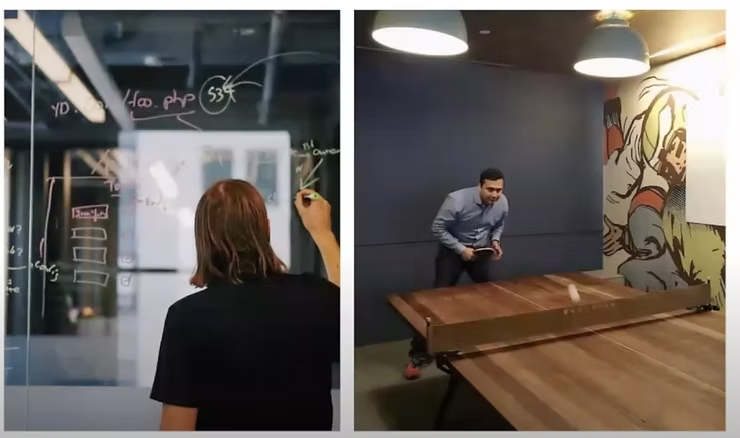
Both Shaunak and Brian worked together with a genuine desire to build a technology tool to improve education. Brian explains, “Building this type of thing is a mission that really resonates with both of us as people.”
A Motivating Story: Goldfish Snack Crackers?
One of Brian’s earliest memories of his education experience was in high school when he had a teacher teaching rote Algebra 2 from the textbook. This teacher would always snack on Goldfish crackers while lecturing. Throughout the course, Brian found himself sitting in seemingly meaningless lectures, learning about Algebra without actually knowing how to apply it to real-world situations. It wasn’t until he started studying physics that he realized that his math course materials did have applications in the real world. Before that, he was really just doing practice exercises without contextual evidence.
In that same Algebra 2 class, he discovered that he learned a lot more when he was with peers rather than studying and learning everything solo. This was because in between the class time, there was a lunch break that split the class into two parts, so when it came time for exams and assessments, Brian and his peers would discuss with each other the content of the exams in that time — and he would learn more during that time than during the regular class time. This helped Brian realize early on in his education experience that group learning was a lot more impactful.
Yellowdig in 2014: Transforming Classrooms into Active Learning Communities
Many instructors want to engage their students in their classrooms, whether it be online or in-person. However, with so many different types of students with different learning styles and different views and different personalities, it’s almost impossible. When Shaunak was thinking about new solutions, he asked himself, “How do we turn this classroom into a community where students are engaged with one another? So that if somebody has a question, they don’t have to wait until the next class to ask the professor. They can whenever they want to.”
Sometimes, students simply want to discuss current events related to the course material. Take for example a Finance class. A buzzword floating around that area of study would be “CryptoCurrency,” and students probably want to talk about that with their peers and professors to feel connected.This was an issue that Brian Hurlow faced early on in his education was the fact that he couldn’t apply his learnings from class into the real world.
Without being able to connect in this way, students may begin to wonder why they’re even taking this specific course at all.These issues were all problems they sought to fix when developing the Yellowdig platform in 2014. Shaunak wanted to create a system where students could freely have thoughtful conversations that would be difficult to have in larger lecture halls.
Using Gameful Learning to Solve Student Engagement Problems
Yellowdig’s approach to gameful learning was to find a solution for lack of engagement in classrooms without exerting extra effort from instructors so that they could focus on what they do best: teaching and learning.
Here are some of the principles that they had in mind when building an effective gamification system:
Self-directed
Delightful and Positive
Rewarding Good Behaviour
Compounding Value
Reduce Administrative Work
When students are assigned to finish a traditional discussion board, most of them won’t log on to do it until Sunday, or the night before the discussion board is due or what have you. In these settings, students typically finish these assignments by doing the bare minimum — just enough to please their professors or get a passing grade.
Through gamification, Yellowdig drives the right behaviours of the students by creating incentives in the platform that help them change their habits and behaviours. The virtual classroom platform encourages students to self-drive their learning instead of being told what to do so that they can have a more delightful environment to have conversations in. Shaunak explains, “We have never engaged in a game which is not feeling good for ourselves.” If students can begin to find the value in active participation, there are more opportunities for students to have conversations with each other and learn with each other based on their own interests.
Something important that both Shaunak and Brian have learned over the years is that they shouldn’t focus so much on building the perfect gameful learning system, because human behaviours are really difficult to analyze and are ever changing, but rather to build something that they can tune over time to try to get to the right game that drives the right behaviour.
Future Developments With Online Programs
Building Feature Sets Before incorporating new feature sets into the platform, Yellowdig’s team first listens to some of the problems that instructors may have with engagement, and then we build a solution around the issue. We then measure those features to see whether or not they are solving the problem or not.
Machine Learning/A.I. Models Currently, Yellowdig is looking into this area in partnership with institutions to see how these models can actually help instructors and students in their education journey. It is something that Shaunak and Brian are excited about working on so they can provide real-time feedback through these models.
Ecosystem Integration One of Yellowdig’s ongoing goals is to strive to be more flexible. Yellowdig has already deployed seamless integration with many common LMS, like Canva, Blackboard, and more. As Shaunak and Brian continue to scale the platform, they are continuing in working on building more integrations with any type of virtual learning software based on instructors’ needs. For more updates on Yellowdig’s platform, make sure to check out our blog and subscribe to our monthly newsletter.
Watch the full webinar here: https://youtu.be/fdLEK2jXpyw