Accessibility has always been an important topic in education because educators want to ensure that everyone—regardless of age, disability, or lifestyle—can have access to a quality education. With the rise of virtual classes, a fully online education is more accessible than ever by allowing students to learn anywhere synchronously or asynchronously. In this blog, let’s highlight exactly how virtual learning makes education more accessible and who it affects the most.
How does virtual learning impact the accessibility of education?
Virtual learning can be done anywhere.
Gone are the days where the only way you can receive a high quality education is going to a brick and mortar campus in a traditional classroom. The rise of COVID-19 showed the world that we have the infrastructure to provide online courses for students in order to keep them healthy, but this doesn’t mean we have to halt online education in a post-pandemic world. Having the option to receive a quality education anywhere opens the door to a better future for everyone regardless of location, which can enhance the learning experience of students. Some may believe that students will lose the social aspect of learning, but Yellowdig’s Engage platform offers a way for students to connect in online or blended learning environments. Because of the resources and tools available to educators, institutions should continue investing in virtual learning to make education more accessible for ALL students.
Virtual learning allows for more people to receive an education.
The typical eighteen to twenty-two year old college student isn’t so typical anymore with more older adults attending school than ever before. Virtual learning gives more people the opportunity to go to college despite varying lifestyles. Students get sick, have jobs, or have life responsibilities that they need to fulfill, and virtual classrooms can be the answer to giving students the accessibility they need to be successful. We shouldn’t put barriers on education because of a person’s lifestyle, and a virtual education can help knock those barriers down.]

Who benefits from more accessible virtual learning?
Students with disabilities
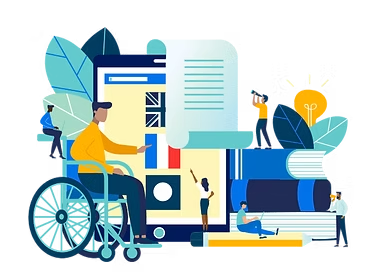
Disabilities come in a variety of forms with many being invisible to the general public. Virtual learning can provide accessibility to students with disabilities by offering them more choices in how they receive their education. Everybody learns differently, and with virtual learning a new reality, it should be a choice for everyone—especially those with disabilities.
Parents
It isn’t uncommon for parents to work all day, care for their kids after, and still attend traditional classes at night at their local school in order to further their education and career. Traveling to a physical classroom isn’t possible for all parents, especially for single parents who may have to hire a babysitter making education even less accessible. Becoming a parent shouldn’t mean you lack access to an education. Instead, parents should have access to online learning environments in order to make higher education more accessible.
Those with full-time jobs
Working a full-time job leaves you little opportunity to attend college if in-person learning is the only option. In fact, 1-in-4 full-time college students are working a full-time job which makes balancing a career and education virtually impossible. Having an online class as an option means full-time workers can enjoy the benefits of a quality education in their own home. This alleviates the burden of being forced to commute to a college campus which may be a challenge for those living in rural areas. Unfortunately, many people working full-time jobs have been barred from receiving a higher education because they are working while most classes are in session. Full-time workers now have more opportunity and accessibility to further their education thanks to virtual learning. Explore how Yellowdig improved the education of adult learners in our latest case study.
Everyone across the world
At the end of the day, everyone, regardless of where you are from, can benefit from the accessibility of virtual learning. The subtracted cost of on-campus housing, daily commuting, and meal plans means students have more money in their pockets at the end of the semester. Not only do they have more money, but they also have more time to spend with their friends and family as well as pursuing their hobbies and aspirations.
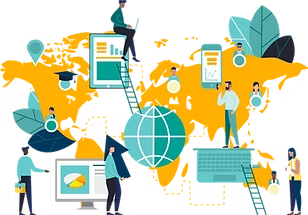
Virtual learning also allows for those of different cultures to connect, interact, and learn with each other to build stronger interpersonal connections. A learner based in the US can learn Japanese from someone who lives in Japan without booking an expensive flight thanks to the accessibility that virtual learning provides. Virtual learning creates environments where we can more easily make our cultures and ideas more accessible with everyone across the globe.
Last remarks
Everyone should have access to education despite their location and lifestyle, and virtual learning offers an opportunity for those who can’t forego their current lifestyle to attend college in the traditional sense. Looking to the future, we hope to see more innovation in the accessibility of virtual learning. Virtual learning can have a positive impact on so many, so it’s a no-brainer to ensure these online learning environments become part of the new normal.
Want to innovate education for the next generation of learners? Learn how you can be a part of the solution by clicking the button down below.